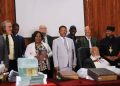



On August 2, the Water Ministers of the Nile Basin Initiative converged in Kampala, Uganda, for the 32nd Nile Council Ministers (Nile-Com) and the 27th Nile Equatorial Lakes Council of Ministers meetings. The atmosphere was lively as the ministers congratulated Burundi for having become the fifth country to have ratified the Cooperative Framework Agreement (CFA), and South Sudan for having acceded to it, fulfilling the six-nation requisite that would see it become enforceable.
The CFA is a framework that intends to establish a framework to “…promote integrated management, sustainable development, and harmonious utilization of water resources of the Basin, as well as their conservation and protection for the benefit of present and future generations,” according to a description posted on the NBI Portal. Both in spirit and text, therefore, the CFA sets out to part with the traditionally hegemonic and narrow-based relationships among riparian countries.
The CFA was signed in 2010 in Entebbe, Uganda, after years of negotiations among riparian countries including Egypt and Sudan, who later reneged after their ideas of maintaining their “historical rights” to the Nile waters were vehemently challenged by the others.
RELATED POSTS


During the latest meeting, Sam Cheptoris, chairman of Nile-Com and the Ugandan minister of Water and Environment, remarked that “the actions of the two countries (Burundi and South Sudan) have enabled us to realize six basin states that have ratified or acceded to the CFA. With the latest development, we are well set to move forward with the establishment of the Nile Basin Commission.”
Article 43 of the CFA states that the legal instrument will enter into force on the sixtieth day after the sixth country that has ratified or acceded to the document has deposited the instrument of ratification or accession with the African Union. That will fall on October 6, 2024. It is worth noting here that South Sudan has only had to accede, and not ratify, to the CFA because the nation of the Republic of South Sudan did not exist at the time of the signing more than 14 years ago.
Ethiopia ratified the CFA on 18 June 2013, Rwanda on 28 August 2013, Tanzania on 20 March 2015, Uganda on 15 August 2019, and Burundi on 23 August 2023. On 8 July, the Transitional National Legislative Assembly (TNLA) unanimously decided to accede to the CFA, rendering it a full-house status. Kenya is yet to ratify it, and its reluctance, according to sources who asked to remain anonymous, can be ascribed to some misunderstanding it has with Ethiopia in relation to the use of the Baro river, a river that flows into Lake Turkana covering an area just on the border of the two countries.
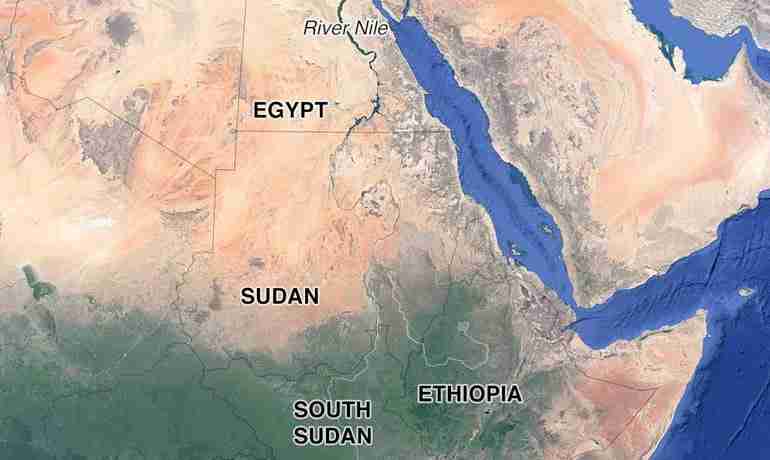
The Democratic Republic of Congo, Sudan and Egypt never signed the CFA, with Egypt persisting in rejecting any move that it fears might come against the 1959 water sharing agreement that it signed with Sudan, taking 55.5 billion cubic meters (BCM) for itself and giving Sudan 18.5 BCM of the Nile waters. Ethiopia, who contributes 86 percent of the Nile’s water, was never part of that agreement and was left with zilch for a share in what is arguably the region’s most important river. That colonial treaty has since remained a point of heated objection by the upper riparian countries.
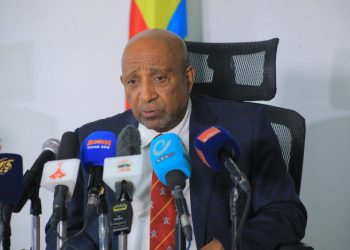
“Now that the six countries have ratified or acceded to it, the next step is that the African Union, with which the countries have deposited their instruments of ratification or accession, will second it on the 60th day of the deposition of the last instrument,” Fekahmed Negash, expert on Nile issues and a former executive director of the Eastern Nile Technical Regional Office (ENTRO), told The Reporter Magazine.
He said the day to crack open the champagne, however, is yet to come.
“While nothing prevents the six countries from establishing the long-awaited Nile Basin Commission as per schedule, they will have to deal with Article 14(b), a sub-clause that had been annexed to the CFA document,” said Fekahmed, who used to serve as director of transboundary rivers affairs at the Ethiopian Ministry of Water, Energy and Irrigation.
He foresees the soon-to-be Commission will resolve issues surrounding this article within the first 60 days following the establishment of what will come as the supreme decision-making body on everything Nile.
What is Article 14(b)?
Fekahmed explains the annexed sub-article relates to the claim made by Egypt and Sudan to the 1959 water rights agreement that came into being to the exclusion of all other riparian countries.
“The two countries wanted the colonial water sharing agreement recognized by the CFA,” said the expert.
The clause that relates to Article 14(b) reads: “Annex on Article 14(b) to be resolved by the Nile River Basin Commission within six months of its establishment [sic}. At the end of the negotiations, no consensus was reached on Article 14(b) which reads as follows: [sic] not to significantly affect the water security of any other Nile Basin State, all countries agreed to this proposal except Egypt and Sudan. Egypt proposed that article 14[b] should be replaced by the following wording (b) not to adversely affect the water security and current uses and rights of any other Nile basin State. The Extraordinary Meeting of the Nile Council of Ministers held in Kinshasa, the Democratic Republic of Congo, on 22 May 2009 resolved that the issue of the Article 14(b) be annexed and resolved by the Nile River Basin Commission within six months of its establishment.”
That decision, coupled with other events and developments, eventually led to Egypt and Sudan leaving the CFA and the subsequent suspension of their NBI membership in 2014. Ever since, the NBI has been calling for the two downstream riparian countries to rejoin by recognizing the need for a broad-based, reasonable utilization of the shared resource.
Two Treaties
In a write-up published on the ‘International Water Law Project Blog,’ Salman M.A. Salman (PhD), a renowned Nile researcher and consultant, reiterated the same call.
“The entry into force of the CFA will create new momentous realities which Egypt and Sudan cannot, and indeed, should not, overlook or underestimate. It will enable the establishment of the Nile Basin Commission replacing the NBI with wider and more elaborate mandate, powers, visibility and recognition by the world water and development aid communities,” reads his commentary. “Entry into force of the CFA will also end the long endemic and futile debate on the Nile colonial realities. Thus, it is for Egypt and Sudan’s own interests to join the CFA, and to work in the spirit of cooperation with the other Nile riparians to manage, share, develop and protect the Nile River Basin.”
Salman observes the CFA was modeled on the United Nations Watercourses Convention endorsed in 1997 by more than 100 countries. Meanwhile, Fekahmed notes the CFA will not in any way replace the 1959 colonial treaty made between Egypt and Sudan, but points out the agreement will have considerable legal ramifications.
“Now the international community has a better legal instrument and a cooperation framework to fall back on whenever dealing with pertinent issues. So far, whenever disputes arise between and among Nile riparian countries, the international community only has the 1959 colonial treaty to refer to,” he said. “With the CFA becoming an international legal document, it is up to the international community to compare it with the 1959 treaty and take on the better of the two.”
Fekahmed also made a comparison between the mandates of the soon-to-be established Commission, an inter-governmental body to be presided over by the heads of state and government of member nations, and the Nile Basin Initiative. The NBI has been a body responsible for engaging in technical issues that include facilitating communication channels between and among member states, offering consultancy, policy harmonization, provision of support in design of specific projects and programs as well as capacity building.
“The Nile Basin Commission will have a broad range of mandates; it may elect to share the Nile waters by volumes among member countries or it may focus on management or any other mode of utilization as long as the spirit and letter of the CFA is adhered to,” said Fekahmed.
Most importantly, he notes, the CFA will have the mandate to borrow money from international creditors.
The mandate to borrow money from international creditors is particularly reminiscent of the age-old injustices the upper riparian countries have had to face, with no international financier willing to fund national projects on the Nile. This lack of international funding compelled Ethiopia, for instance, to mobilize domestic resources largely in the form of public bonds to finance the construction of the Grand Ethiopian Renaissance Dam (GERD), a hydroelectric scheme with an installed capacity to generate 5,150 megawatts.
Studies project that by 2025, 600 million people will call the Nile River Basin home. The river flows more than 6,800 kilometers, drawing water from 11 countries in the basin before meeting the Mediterranean. More than 85 percent of the Nile waters originate in Ethiopia and these waters support some of the highest population densities in the world, in excess of 2,000 persons per square mile.
“The potential economic benefits from the cooperative use of the Nile’s water is estimated to be worth well over USD 11 billion. But being able to harness those benefits is a far reach; the Nile basin has a growing need for infrastructure investments to attain the full potential of this resource. Many of these infrastructure investments need to be coordinated between the basin’s 11 countries to ensure they are creating mutual benefits and are not causing harm to neighboring countries,” reads an article published on the World Bank Blogs by Arsene Aimer and H. Hukumbwa.
This encapsulates the foundational thinking that led to the creation of the CFA, pointing also to the need to foster a spirit of cooperation across the Nile Basin, rather than cut-throat competition.
Turning Tables
In spite of the CFA having been accepted by the wider Nile Basin community as a viable means for future cooperation, there are doubters who question its viability without the involvement of the lower riparian countries: Egypt and Sudan. They argue that since the two countries are not signatories, they cannot be expected to abide by its terms, while at the same time continuing to implement their respective national projects that affect the whole Basin.
While the issue at hand is more complex than meets the eye, an Ethiopian who authored two books on Nile geopolitics, Selabat Manaye argues “the tables have turned” on the hegemonic views.
“The CFA will change the much skewed relationships advanced by Egypt for decades on end when it comes to actual utilization of the Nile River,” Selabat told The Reporter Magazine. He observes that the CFA has now clearly stipulated rights, obligations and principles towards long-term and sustainable utilization of the shared resource.
“The CFA gives all riparian countries a fair amount of legal and political leverage, while Egypt will be facing much pressure to come back to the fold of the CFA and respect the rights of other nations to utilize the shared resource in a reasonable and equitable manner,” he said.
According to him, the CFA would also serve as a basis for the signatories to solicit and secure international partnerships and financing, now that the tide has turned
The agreement on the Nile river Basin Cooperative Framework is composed of 44 Articles, and stipulates that the Commission that is established as an intergovernmental organization “shall enjoy international legal personality….”
With its alpha and omega being the principle of equitable and reasonable utilization, the CFA also includes obligations that signatories have to live up to in terms of protecting the Basin, and the sharing of data and information on specific projects.
Part III of the treaty lays down the CFA’s organs: the Conference of Heads of State and Government, the Council of Ministers, the Technical Advisory Committee, Sectoral Advisory Committees, and the Secretariat. The NRBC would inherit the rights, obligations and assets of the NBI, which has been in existence since 1999 as an intergovernmental body presided over at the level of water ministers. The soon-to-be established Commission will be presided over by the heads of state and government, and will serve as a supreme decision-making body on all things the Nile.