
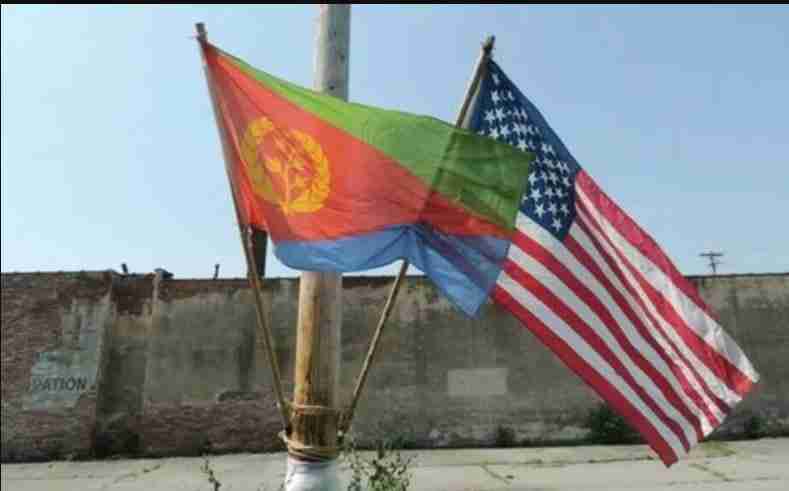

Reports published in recent weeks indicate that Washington is considering a normalization of relations with Asmara, spurred in part by Eritrea’s control of over 1,000 kilometers of Red Sea coastline.
The administration of US President Donald Trump is in talks with the Eritrean government as Iran and its Houthi allies in Yemen threaten to choke off a second vital maritime corridor against the backdrop of war with the United States.
The talks, reportedly led by Trump’s senior Africa advisor, Massad Boulos, are being facilitated by the Egyptian government, which itself has strengthened links with Asmara in recent years.
RELATED POSTS
Reports indicate that US officials have proposed dropping economic sanctions against Isaias Afewerki’s regime and improving diplomatic relations. These specific sanctions were levied against the Eritrean regime in the wake of the two-year war in northern Ethiopia, where Eritrean troops are accused of committing grave rights violations.
But even so, Eritrea-US relations have been frozen for decades. Successive US administrations have kept the US ambassador post in Asmara vacant, and US lawmakers have repeatedly criticized Isaias Afwerki’s government for human rights abuses.
But Eritrea’s strategic role, given its hold on the Red Sea coast, has risen sharply due to the US-Israeli war against Iran. Eritrea controls over 1,100 kilometers of Red Sea coastline, including the northwestern side of the Bab el Mandeb Strait, through which 12 percent of the world’s maritime oil shipments pass.
Other reports also show that the Trump administration is keen on boosting the military ties of its Africa Command (AFRICOM) across the continent. Currently, its only major port base is in neighboring Djibouti. Earlier this month, AFRICOM launched a joint counter-terrorism mission in Sirte with Libyan and Italian armed forces.
Shimelis Hailu, assistant professor and researcher at the Institute of Foreign Affairs, contends that Washington’s recent overtures to Asmara should be viewed through the lens of a world order undergoing volatile and unpredictable shifts.
He notes that the contemporary international order is markedly different from the post-Cold War era, also known as “The New World Order,” which was characterized by a unipolar system led by the United States, backed by European allies, and defined by a shared commitment to multilateral diplomacy and institutions.
“Today, that system is under pressure. The world is transitioning from unipolarity toward an uncertain multipolar order. In this global phenomenon, new and unclear systems of international relations and diplomatic games have emerged,” said Shimelis.
One key development is the proliferation of actors, which has effectively diluted once-unified global systems.
“We are now witnessing many nations setting aside collective security, multilateralism, global norms, human rights, and democracy in favor of inward-looking policies focused on national security, strategic interests, and a rising sense of nationalism,” he further explained.
A major driver of this shift is the United States itself, due to both international changes and internal dynamics—most notably the rise of Donald Trump. Trump’s presidency has fundamentally altered traditional US foreign policy. Trump has overseen a partial retreat from US-led globalism, rejected multilateralism, and championed “America First” over collective security. By ignoring international norms and the responsibility to protect, Trump has introduced a doctrine of “selective engagement,” which involves cooperating only with those actors that serve US national interests, Shimelis noted..
This approach is shaped by Trump’s personality and business background. Pragmatic to the point of being transactional, Trump adheres to a “Golden Rule”, which states that those who have the gold can make the rules or shape the rules. Traditional diplomatic tools such as “naming and shaming,” protecting national integrity, or upholding trust are set aside in favor of securing advantages for the powerful.
“That emanates from the current global reality and Trump’s personality,” said Shimelis. “Trump is a businessman, not a career politician; history, political systems, and diplomatic protocols make little sense to him. What matters is business and profit. His foreign relations are therefore based on transactional diplomacy and deal-making.”
This US and global reality, along with Trump’s demands, heavily influences the policy toward Eritrea. Historically, US foreign policy was characterized by strong institutions—the Pentagon, the Treasury, and diplomatic networks, and intelligence agencies—working in relative consistency.
“Under Trump, however, this has split. On one side, traditional foreign policy institutions continue formal work. On the other, Trump has created his own ‘Deep State’—an informal network of actors that often operates independently, at times at odds with official channels. The world now engages with America through two parallel systems,” Shimelis explained.
“Eritrean issues, the Middle East war, Venezuela, and other policies in the Middle East—that’s the work of Trump’s deep state.”
Trump’s “Deep State” consists of three main entities.
The first one is the business community, leveraging Trump’s commercial background to identify opportunities across the globe and to facilitate business.
The second group is close associates and foreign leaders who influence policy on specific countries—for example, Saudi Arabia’s Crown Prince Mohammed Bin Salman on Sudan, or Egypt’s President al-Sisi on Eritrea.
The Third are lobbying groups, especially those tied to religious organizations that affect politics.
“On Eritrea, it appears to be Trump’s ‘’Deep State,’ particularly actors linked to Egypt, rather than formal US agencies, that are shaping policy,” said Shimelis. “Additionally, security concerns surrounding the closure of Bab-el Mandeb strait by the Houthi rebels—exacerbated by the situation in Iran—offer economic incentives for Washington to engage Asmara.”
From Ethiopia’s perspective, this creates a dilemma, bringing both opportunities and challenges.
Shimelis observes that on the positive side, US outreach to Eritrea does not necessarily mean abandoning Ethiopia. Trump aspires to be seen as a peacemaker—even to win a Nobel Peace Prize—and has sought credit for resolving conflicts such as between Azerbaijan and Armenia, or potentially between Ethiopia and Egypt (though this is far from the truth). If handled through negotiation, a pathway could emerge for Ethiopia and Eritrea to cooperate and share access to the Red Sea without conflict.
“Given rising tensions in the region—the Iran-aligned ‘Axis of Resistance,’ Houthi activities, and the Muslim Brotherhood’s growing influence in Sudan, Yemen, and Somalia, Washington may see value in bringing Ethiopia and Eritrea together, alongside pro-US actors like Israel, to counter anti-American forces,” he said.
“Notably, this process would likely occur through Trump’s ‘Deep State’ rather than traditional diplomatic channels. Ethiopia could leverage its own ties with countries close to Trump—such as Israel, Azerbaijan, or Argentina—to foster conflict-free and sophisticated diplomacy,” explained the expert.
On the other hand, the challenge for Ethiopia is that if figures like Al-Sisi or the Saudi crown prince are driving US policy toward Eritrea and Sudan—potentially due to power competition with the United Arab Emirates in Sudan—they may seek to encircle Ethiopia, according to Shimelis.
“They could misinform Trump to further distance Ethiopia from the Red Sea, leaving it an encircled, contained state in the Horn of Africa with diminished influence. This is a credible threat that requires proactive counterstrategies,” warned the expert.
A political analyst who spoke to The Reporter Magazine anonymously noted that ties between Eritrea and US leaders have been marked by controversies since the 2000s, especially after the September 11, 2001 attacks and Somalia-related terrorist activity, which led to sanctions being levied against Eritrea.
“These sanctions, levied by the UN’s veto powers, have had negative consequences on the economic development of Eritrea,” he said.
The most significant sanctions targeting Eritrea for alleged terrorism-related activities were implemented via the UN Security Council (UNSC) with heavy backing from the US, driven by accusations that Eritrea supported al-Shabaab in Somalia. UNSC Resolution 1907, adopted in 2009, imposed an arms embargo, travel bans, and asset freezes on Eritrean political and military leaders. UNSC Resolution 2023, implemented in 2011, strengthened sanctions by requiring Eritrea to cease all efforts to destabilize the region and mandating that states prevent the import of Eritrean minerals.
These sanctions lasted for nearly a decade and, combined with scrutiny of foreign transactions, severely hampered Eritrea’s financial operations and access to foreign currency, causing significant economic damage.
Meanwhile, Ethio-US relations were elevated to a strategic partnership on counter-terrorism in the Horn of Africa.
The UN and European Union (EU) lifted their embargoes on Eritrea in 2018, amid what appeared then to be a normalization of relations with Ethiopia and other neighboring countries. The rapprochement, which began when Prime Minister Abiy Ahmed (PhD) took office, fell apart in the wake of the northern war and Eritrea’s relations with Ethiopia have reverted to their pre-2018 tensions.
In October 2024, Eritrea, Egypt, and Somalia forged an alliance aimed at bolstering regional security and checking Ethiopian influence. The agreement came as Ethiopia and Somalia were caught in a dispute over the former’s maritime access-for-recognition agreement with breakaway Somaliland.
A year later, Eritrea withdrew from the Inter-Governmental Authority on Development (IGAD).
Still, the political analyst argues that Washington’s efforts to warm up to Eritrea could have positive implications for Eritrean citizens and Ethiopia. He predicts that foreign policy values such as respect for human rights, democracy, constitutions, and a free press, which could be presented as preconditions for normalization.
“Accustomed to sanctions, Eritrea may not see all sanctions lifted quickly; rather, which sanctions are lifted—military, security, or economic—will depend on improvements in the Eritrean government’s characteristics,” he explained. “As far as the US pursues its national interest, it may set rapprochement between Ethiopia and Eritrea as a precondition, which aligns with President Trump’s rhetoric to protect world peace. However, the US priority is to protect Bab el Mandeb from Houthi rebel attacks to prevent supply chain disruptions—Eritrea could be delegated to do so.”
He also said US foreign policy evolves over time, and Washington will focus on creating a safe trade route in the region. It will also work to support Israel’s efforts toward Somaliland’s recognition to control the situation in Somalia.
“This geopolitical change could improve the security situation in the region,” he said.
Nonetheless, the analyst warns that conflicts arising in the Red Sea will also undoubtedly affect Ethiopia, including disruptions to the global supply chain, and urges the government to work collaboratively to solve such predicaments, even potentially becoming an observer state.
While the Trump administration’s plans for Eritrea are not yet official, reports indicate that talks with Eritrean officials will continue. Where they will lead remains to be seen.