

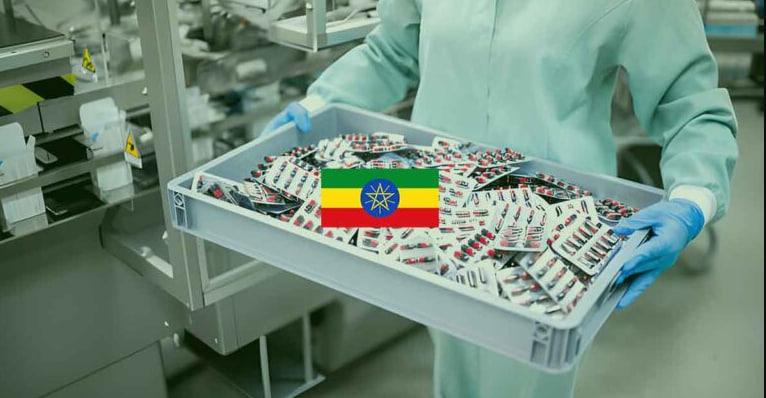

When Yeshihareg Abebe, a woman in her late 40s, was diagnosed with hypertension, she was prescribed amlodipine—a common blood pressure medication—to be taken once nightly. What proved less straightforward was the long-term cost of her prescription.
Initially, Yeshihareg purchased a German-manufactured brand at roughly 290 birr per strip. Once her physician confirmed the medication would be a lifelong necessity, she inquired about a more affordable alternative. Switching to a locally manufactured version reduced her cost to just 30 birr per strip—a ten-fold savings that recurs every month.
A spot check by The Reporter Magazine at an Addis Ababa retail pharmacy revealed a similar disparity. Locally manufactured 5 mg amlodipine retailed at approximately 45 birr per strip, compared to 305 birr for the German equivalent. For the antibiotic ciprofloxacin (500 mg), the spread was even starker: 80 birr for local production versus 355 birr for a Saudi brand, 430 birr for a Turkish product, and 1,080 birr for the German brand.


While prices vary across outlets and brands, these figures illustrate why domestic production offers immediate relief at the pharmacy counter. Yet price is only part of the equation—availability, quality, and supply chain depth reveal a far more complex reality.
Elham Reshid, Founder and Managing Director of EL Healthcare Consult PLC and Secretary to the General Assembly of the Ethiopian Pharmaceutical Association—a national body representing professional pharmacists—emphasizes that product availability remains highly volatile. She explains that while consumer demand for essential medicines is constant, domestic and imported supply fluctuates unpredictably. A given drug may be widely available for several weeks and then abruptly vanish from pharmacy shelves for months.
As a consequence of these supply shocks, patient behavior has split into distinct patterns. While some patients continue actively seeking imported or familiar international brand names out of habit or perceived quality differences, a rapidly growing segment of the population makes purchasing decisions strictly based on immediate affordability.
“The current economic situation is forcing many people to become more price-conscious,” Elham said.
Yet the tablet resting in Yeshihareg’s hand raises a fundamental structural question that goes to the heart of Ethiopia’s industrial strategy. The physical medicine may indeed be mixed, compressed, and packaged inside a factory in Ethiopia, but its active pharmaceutical ingredient (API)—the precise chemical compound that produces the intended therapeutic effect in the human body—was synthesized elsewhere.
Furthermore, the vast majority of non-active ingredients, specialized machinery, and primary packaging materials required to produce that tablet were also imported from abroad. The central issue facing health authorities and economic planners is therefore not simply whether Ethiopia can formulate medicines locally, but how much of that medicine’s true value chain actually resides within the country, and how far domestic industry has moved from basic assembly toward genuine manufacturing depth.
How Much Is Truly Local?
A study conducted by the Ministry of Health, titled Assessment of Local Pharmaceutical Manufacturing Market Share in Ethiopia and published in the Ministry’s 27th Annual Review Meeting Special Bulletin, estimated that locally manufactured medicines met 14.4 percent of Ethiopia’s total medicine demand. The assessment evaluated all 13 large-scale pharmaceutical manufacturing facilities operating in the country during the survey period, integrating data from the Ethiopian Pharmaceuticals Supply Service (EPSS), the Ethiopian Food and Drug Authority (EFDA), and the Ethiopian Customs Commission.
Solomon Abdellah, Local Pharmaceuticals Manufacturing Coordination Focal at the Pharmaceuticals and Medical Devices Lead Executive Office within the Ministry of Health and one of the study’s primary co-authors, explains that this figure reflects the country’s entire pharmaceutical consumption. It incorporates the public health sector, private commercial retail pharmacies, donor-funded national health programs, and international humanitarian donations.
“Simply put, out of every 100 birr worth of medicines used in the country, about 14 birr is produced by Ethiopian factories,” Solomon notes. He stresses that this metric represents the broadest possible measure of national self-reliance and should be interpreted as a realistic baseline for future planning rather than a final indictment of the industry.
However, a second figure reveals a markedly different reality in a more targeted segment of the market. When examining public procurement conducted by the EPSS using government funds under the Revolving Drug Fund (RDF), local manufacturers hold a significantly larger share, supported by measures such as local price preference and advance payments.
This public market share has experienced rapid expansion over recent years. Solomon notes that recent monitoring covering the 2017 and 2018 Ethiopian Fiscal Years demonstrates that locally manufactured products now account for roughly 44 to 45 percent of relevant government-funded pharmaceutical purchases made through the EPSS.
Dr. Tadesse Teferi Mekonen, President of the Ethiopian Pharmaceuticals and Medical Supplies Manufacturing Industry Sectoral Association, outlines a similar upward trajectory. According to association records, the local share of public procurement rose from approximately 8 percent four years ago to around 44 percent over the past year.
His association represents 30 healthcare manufacturing enterprises across the country, including all 14 dedicated pharmaceutical manufacturing plants in Ethiopia. Of those 14 facilities, 12 are currently actively producing commercial medicines, while two remain in various stages of construction and commissioning.
This sharp contrast between national market share (14.4 percent) and public procurement share (44–45 percent) highlights an important structural dynamic in Ethiopia’s healthcare economy. Local manufacturers have successfully secured a firm foothold in public sector procurement by leveraging state purchasing policy, even as their presence in the broader commercial retail market remains modest.
Breadth of production remains another major limiting factor. Of the 548 individual molecules listed on Ethiopia’s official Essential Medicines List, only 103 were being manufactured locally at the time the Ministry of Health conducted its market assessment. While Solomon estimates that this number has since expanded to between 120 and 130 molecules, it means that roughly three-quarters of the fundamental medicines prioritized by the national health system cannot be produced domestically under current conditions.
What Counts as Local? Mapping Supply Chain Dependencies
Even when a medicine is categorized as “locally manufactured,” examining the underlying supply chain reveals deep, multi-layered dependencies on foreign suppliers.
Dr. Mohammed Nuri Osman, Board Chairman of pharmaceutical manufacturer EPHARM S.C., Founder and CEO of Medtech Ethiopia PLC, and a founding partner and board member of Julphar Ethiopia PLC, emphasizes that genuine pharmaceutical manufacturing must be clearly distinguished from simply importing finished dosages in bulk and repackaging them for retail sale.
“The raw materials themselves are generally not produced here. They come from abroad,” Dr. Mohammed told The Reporter Magazine. “We import the pharmaceutical raw materials, do the formulation here, manufacture here using our own professionals, and undertake quality control here.”
Dr. Mohammed states the industry’s central vulnerability directly: virtually 100 percent of active pharmaceutical ingredients (APIs) used in Ethiopian manufacturing facilities are imported from abroad. “There is not a single company in Ethiopia producing APIs,” he noted.
Beyond active ingredients, modern pharmaceutical production relies heavily on excipients—the non-active substances combined with an API to serve as binders, disintegrants, preservatives, flavorings, or stabilizing agents that ensure a tablet dissolves correctly or a liquid remains shelf-stable.
This is where refined sugar becomes an unexpected focal point in the story of domestic localization. Dr. Tadesse explains that pharmaceutical plants consume massive volumes of highly refined sugar to manufacture oral syrups and liquid suspensions, particularly pediatric formulations for young children.
Yet despite Ethiopia having sugar factories, manufacturers still import hundreds of tons because locally produced sugar does not meet the required pharmaceutical standard. The reason is technical: locally produced sugar does not meet the stringent purity and chemical standards required for pharmaceutical manufacturing.
The industry has been discussing the issue with the Sugar Corporation, he said, with the aim of adding another stage of refinement and the required quality testing.
“It is basically adding one layer of refinement,” Dr. Tadesse said.
If achieved, domestic producers could supply pharmaceutical-grade sugar to medicine manufacturers instead of importing a bulky input linked to an industry Ethiopia already has.
Packaging represents another critical layer of foreign dependency where policy mismatches create unnecessary friction. Secondary packaging—such as outer cardboard cartons, paper inserts, and shipping boxes—is increasingly manufactured by domestic printing and packaging companies. However, primary packaging materials—the specialized aluminum foil, PVC film, and blister materials that come into direct physical contact with the medicine to protect it from moisture and degradation—remain heavily reliant on imports according to Dr. Tadesse.
Dr. Tadesse points to a significant policy anomaly regarding tax structures. When a licensed pharmaceutical manufacturer imports primary packaging materials directly for its own internal production lines, the shipment is eligible for duty and tax exemptions under industrial incentive frameworks.
However, if an independent Ethiopian packaging firm attempts to import raw plastic or aluminum inputs to manufacture those same primary packaging materials locally and sell them to pharmaceutical plants, that local packaging supplier is subjected to standard import duties and taxes. These tax costs are inevitably passed along in the final price of the packaging, making locally produced blister packs significantly more expensive than imported equivalents. Consequently, pharmaceutical factories are economically forced to bypass domestic packaging suppliers and import their primary packaging directly from abroad.
“It will be expensive. So, the manufacturers will be forced to buy from outside,” Dr. Tadesse said.
Where Local Production Stops
The structural depth of Ethiopia’s pharmaceutical industry is also defined by the specific categories of medicines it is capable of producing. To date, domestic manufacturing has advanced almost exclusively in relatively simple, high-volume product categories that present lower technical barriers to entry.
Solomon notes that domestic output is overwhelmingly concentrated in solid oral dosages (tablets and capsules), oral liquid suspensions, topical creams and ointments, non-sterile liquid formulations, and basic medical consumables.
Dr. Tadesse observes that local factories are heavily clustered in similar therapeutic areas, including commonly used antibiotics, ant parasitic and antifungal medicines and some treatments for hypertension and diabetes.
One notable area where local production has advanced much further is the manufacturing of intravenous fluids, sterile liquids such as normal saline and glucose solutions administered directly into a patient’s bloodstream. Dr. Tadesse says Ethiopia is now virtually self-sufficient in large-volume IV fluids.
Beyond these established lines, however, the technological gaps in Ethiopia’s manufacturing footprint widen dramatically. Solomon highlights that major structural deficits persist in small-volume sterile injectables, biological products, complex vaccines, insulin, and specialized oncology treatments for cancer care.
Furthermore, domestic producers do not currently manufacture complex medical devices or advanced diagnostic reagents. Crucially, medicines required for high-priority national health programs targeting HIV/AIDS, tuberculosis, and malaria remain beyond the reach of local plants because domestic facilities have not yet secured the World Health Organization (WHO) prequalification required to participate in internationally financed, donor-funded procurement drives.
Dr. Tadesse described an industry in which several factories may compete to make the same relatively simple medicines while entire therapeutic areas remain dependent on imports. Paracetamol is one example of concentrated local competition, he said, while anesthesia and cancer medicines remain outside domestic production.
This concentration of production raises fundamental questions not only about how many individual products are manufactured locally, but about the strategic nature and complexity of those products.
For Dr. Mohammed, it is also a question of overall industrial scale. He emphasizes the fact that Ethiopia currently operates around 12 active pharmaceutical factories serving a national population exceeding 130 million people. By comparison, neighboring Kenya hosts more than 80 pharmaceutical manufacturing plants, despite having approximately one-third of Ethiopia’s total population.
Built to Produce More: The Underutilization Paradox
Perhaps the most startling finding of the Ministry of Health’s assessment is that Ethiopia’s existing pharmaceutical factories are operating at a tiny fraction of their built mechanical capacity.
The Ministry study revealed an average installed-capacity utilization rate of just 24 percent across the assessed manufacturing facilities. Most strikingly, industrial tablet production lines were found to be operating at an average of merely 4.14 percent of their total design capacity. In effect, vast industrial machinery, cleanroom environments, and automated packaging lines sit idle for the vast majority of the operational year.
The underutilization is attributed to a combination of severe macroeconomic and operational bottlenecks. Chief among these is the chronic scarcity of foreign exchange required to secure imported APIs and specialized excipients, chronic shortages of working capital, intense competition from low-cost foreign generic imports, the high financial cost of upgrading older facilities, and electrical power interruptions.
Dr. Mohammed said his own factory had historically operated below 50 percent of capacity, although performance improved over the past two years to around 60 to 65 percent. However, he emphasizes that pharmaceutical manufacturing inherently ties up vast amounts of liquidity for extended periods.
Raw materials purchased overseas often spend several months in international transit, maritime shipping, and customs clearance before arriving at the factory gate. Once inside the plant, these inputs must undergo rigorous laboratory testing and quarantine protocols before formulation can even begin. Subsequent manufacturing, batch testing, quality assurance release, and distribution add several more months to the operational timeline before finished products generate actual cash revenue.
Because this production cycle is extraordinarily long, pharmaceutical enterprises require massive, sustained working capital to maintain continuous production runs. Dr. Tadesse identifies access to finance as one of the most paralyzing constraints facing the sector today. He warns that without adequate working capital and trade finance mechanisms, those manufacturing plants costing tens of millions of dollars risk becoming little more than “white elephants.”
Dr. Tadesse explains that local manufacturers struggle to secure loans from commercial banks, endure lengthy administrative delays during credit evaluations that cause them to miss critical market opportunities, or successfully secure working capital loans denominated in Ethiopian birr while remaining unable to convert those funds into the foreign currency needed to purchase raw materials abroad.
“They prefer to lend me for trading than for manufacturing,” he said of Commercial banks.
Dr. Tadesse points out that local pharmaceutical manufacturers signed more than 40 billion birr worth of procurement contracts with the EPSS over a two-year period. In his view, these guaranteed public purchase agreements should represent an ideal, low-risk lending opportunity for the banking sector.
He advocates for the adoption of “contract-anchored lending,” an innovative financial arrangement where a confirmed government supply contract serves as primary collateral for bank financing. Under a formalized tripartite agreement, banks could extend immediate working capital against secured orders, with future contract payments routed directly through the lending institution to settle the debt.
He argues that confirmed supply contracts could be used more effectively to support financing. Under what he calls contract-anchored lending, he proposes using a confirmed government supply contract as an anchor for financing through a tripartite arrangement tied to the contract and its payment flow, allowing manufacturers to obtain working capital against orders they have already secured.
Dr. Mohammed identified another vulnerability: spare parts for pharmaceutical machinery are not readily available locally. A failed component can leave a production line idle while awaiting an imported replacement.
This underutilization directly impacts consumer pricing. Dr. Mohammed cautions against assuming that locally formulated medicines will automatically be cheaper than imported equivalents under all circumstances. Massive manufacturing conglomerates in India or China supply global markets at an enormous volume, allowing them to achieve economies of scale that push unit production costs down to levels an Ethiopian factory operating at 25 percent capacity cannot currently match.
However, for high-volume, essential medicines, domestic production consistently reduces overall foreign currency expenditure. By importing raw chemical ingredients rather than paying foreign currency for all the added value, labor, and profit margins built into a finished imported drug, local formulation allows the country to conserve precious foreign exchange reserves while lowering retail costs for common treatments.
When Procurement Shapes the Market
Given these operational hurdles, public procurement policies have become the principal tool for creating predictable market demand and sustaining the domestic industry.
Dr. Mohammed highlights that the EPSS grants local manufacturers a financial price preference of up to 25 percent during competitive public tenders.
“When they purchase from us, even if our price is higher than the imported price, we can receive a price preference of up to 25 percent. That is not a small thing,” he said.
Additionally, EPSS policy allows for advance contract disbursements of up to 30 percent, providing manufacturers with upfront capital to procure raw materials before production begins.
Dr. Tadesse notes that these advance disbursements are not consistently received in full.
“Sometimes we get 30 percent, other times we get 10 percent, 20 percent, other times we don’t get at all,” he said.
Furthermore, procurement contracts create severe financial risks during periods of macroeconomic volatility. Because public supply contracts are fixed in Ethiopian birr for extended terms, manufacturers face severe losses if the local currency depreciates, global freight rates surge, or international API prices rise between contract signing and final delivery.
Dr. Tadesse describes these unhedged cost surges as a “hidden tax” on domestic producers, who remain legally locked into fixed-price contracts while paying escalating prices for imported raw materials. The association is actively lobbying the Ministry of Finance, the Ministry of Health, and federal procurement authorities to establish a formal price-adjustment mechanism within long-term supply contracts to absorb major external economic shocks.
Simultaneously, the industry association is calling for the restoration of historical fiscal incentives, including the reinstatement of a five-year corporate tax holiday that previously supported infant pharmaceutical enterprises, arguing that taxing young manufacturing plants at a 15 percent corporate income tax rate undermines their ability to reinvest in facility upgrades.
What It Takes to Go Deeper
To transition from basic formulation toward advanced manufacturing, Ethiopia must cross critical regulatory and technological thresholds.
A major milestone was achieved in late 2025 when the Ethiopian Food and Drug Authority (EFDA) formally attained WHO Maturity Level 3 for medicines regulation—a benchmark signifying a stable, well-functioning, and integrated national regulatory system capable of rigorous product authorization and market surveillance.
However, at the factory level, compliance with international Good Manufacturing Practices (GMP) remains an ongoing challenge. The Ministry of Health study revealed that only six of the 13 large-scale pharmaceutical manufacturers assessed met full GMP compliance criteria as of early 2025. Furthermore, Ethiopia still lacks WHO-prequalified locally manufactured products, limiting its access to certain donor-funded procurement opportunities.
Establishing an API synthesis plant strictly to supply Ethiopia’s small domestic formulation market is economically unviable. An API facility requires massive upfront capital investments and must operate at enormous continuous volume to achieve profitability, necessitating access to export markets across East Africa and the broader continent.
In this context, the African Continental Free Trade Area (AfCFTA) presents both an export opportunity and an immediate competition.
The same market access works in both directions. “If we don’t help our local manufacturers export to Kenya, and Kenya starts exporting into Ethiopia, we will be playing catch-up,” Dr. Tadesse said.
For an industry already operating well below installed capacity, that raises the cost of delay.
“If we don’t do it right now, it is going to be an uphill battle,” he said.
His message to banks was equally direct.
“Come on board today or you’ll miss the bus.”
Solomon said the National Medicines and Medical Devices Manufacturing Strategy for 2026–2035 is intended to address many of these same constraints—including financing, foreign exchange, and coordination—while establishing a path toward API production and WHO prequalification, expansion into complex products, and access to regional markets.
Dr. Mohammed added that the sector requires a predictable policy framework, long-term financing, adequate foreign exchange, and investment incentives that support local production, technology transfer, quality, and exports.
For Yeshihareg Abebe, the immediate value of domestic formulation is already visible every time she visits her neighborhood pharmacy to purchase her monthly blood pressure medication for 30 birr instead of 290 birr. Yet as Ethiopia seeks to build true healthcare sovereignty, the ultimate measure of success will be determined by how much of that medicine’s underlying journey—from raw chemical synthesis to high-tech packaging—the country can bring within its own borders.