

A NASA-funded air pollution monitoring network spanning three years revealed that the average level of tiny, harmful particles in Addis Ababa’s air was more than three times the U.S. annual health-based standard.
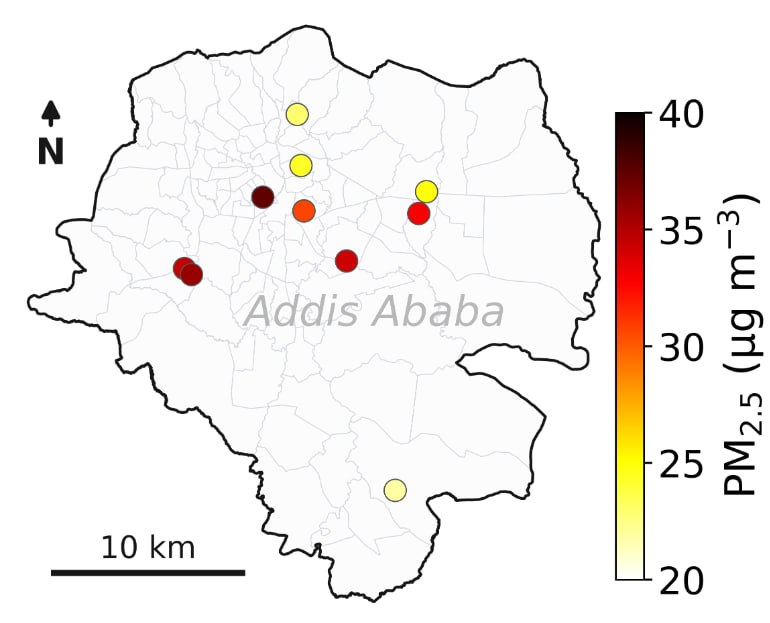
The study published this week examined PM2.5, tiny particles in polluted air measuring 2.5 micrometers or less in diameter. Researchers found an average concentration of 30 micrograms per cubic meter across Addis Ababa between April 2022 and March 2025. NASA said this was more than three times the annual standard set by the U.S. Environmental Protection Agency.
The research, published in ACS ES&T Air in July, used continuous measurements from 10 air-quality monitoring sites across the capital.
RELATED POSTS

The study found that daily levels of this pollution exceeded the World Health Organization’s daily guideline on 98.7 percent of monitored days. It also found that annual average levels at every monitoring site were at least four times the WHO annual guideline during each year of the study.
Pollution was not the same across the city. Black Lion Hospital recorded the highest average level among the 10 monitoring locations, followed by Skylight Hotel and the Reppie waste site. Addis Ababa Science and Technology University recorded the lowest average level.
The researchers also found that pollution generally rose during the morning rush hour, fell during the middle of the day and increased again in the evening. Levels were particularly high during the June-to-September rainy season.
The study separately measured black carbon, commonly known as soot, at two locations in Addis Ababa. A model used by the researchers estimated that 94 percent of the soot measured was associated with fossil-fuel burning, while six percent was associated with biomass burning.
NASA said average soot levels in Addis Ababa were about four to nine times higher than levels measured by the same project in Los Angeles, Atlanta and Boston.
The monitoring also picked up sharp increases in pollution during Meskel and Hidar Sitaten, two annual celebrations involving widespread burning. The study recorded unusually high levels of both fine-particle pollution and soot during these events.
NASA said the findings provide a baseline for tracking how Addis Ababa’s air quality changes over time. The agency noted that Ethiopia banned imports of internal-combustion-engine vehicles in 2024 and that cities are adding electric-vehicle infrastructure and bicycle lanes.
The researchers said this was, to their knowledge, the first long-term study in Ethiopia to continuously monitor both fine-particle pollution and black carbon at multiple locations.