

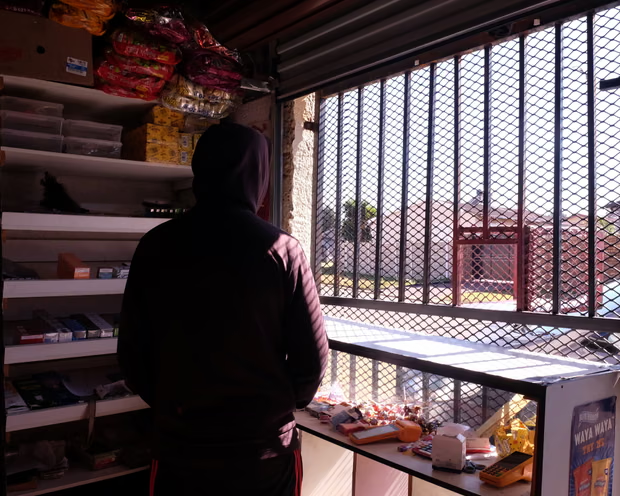

The xenophobic attacks in South Africa, targeting primarily citizens of other African countries, have continued. These periodic attacks, which have recurred over the years, have multiplied in both magnitude and duration this year. Since April, violent vigilante groups have spearheaded these xenophobic incidents.
Anti-immigrant groups such as “Operation Dudula” and the “March and March” movement set a June 30 deadline demanding that foreign nationals leave, relentlessly advocating for their expulsion. Other violent factions enforced this demand through physical attacks, looting, and intimidation. Rather than intervening decisively, the Ramaphosa government and its security apparatus effectively enabled the unrest through inaction. As a report from Human Rights Watch noted, the violence unfolded “with little or insufficient apparent response from the police and other authorities.”
Since the onset of the attacks, foreign ministries from several targeted African nations—most notably Nigeria and Ghana—swiftly summoned South African ambassadors. The Ethiopian Ministry of Foreign Affairs followed suit in early May by summoning the South African ambassador in Addis Ababa. However, these diplomatic moves have brought little relief to immigrant communities in South Africa. Publicly, the South African government appeared to condemn the violence, yet it took virtually no effective action to halt it.


Major urban centers including Johannesburg, Cape Town, and Durban have experienced a major wave of anti-immigrant and xenophobic unrest throughout July 2026, with mobs and vigilante groups conducting door-to-door harassment, targeting foreign-owned businesses, forcing evictions, and looting properties.
Reports indicate that over 160,000 people from African countries such as Nigeria, Ghana, Malawi, Zimbabwe, Mozambique, and Ethiopia have been displaced or forced to leave so far.
Ethiopians have been among the most severely affected. Although an exact official count is elusive, 2024 data from the International Organization for Migration (IOM) estimates the Ethiopian population in South Africa to be as high as 200,000. Many have seen their livelihoods upended, with their small and medium-sized businesses looted, destroyed, or forcibly taken over.
The Reporter Magazine’s Yared Nigussie gathered first-hand accounts from members of the Ethiopian community in South Africa severely impacted by recent xenophobic violence.
For nearly half of his life, Memhiru Melaku believed South Africa was the place where his dreams would take shape.
When he arrived from Ethiopia as a young man almost 16 years ago, he carried little more than determination and the hope of building a better future. Like many Ethiopian migrants before him, he started at the bottom—selling men’s belts from a small wholesale shop on Jeppe Street, a bustling corner in downtown Johannesburg. Every profit was reinvested in another step toward stability.
Years later, the modest belt trader had become a successful entrepreneur. He owned a chain of supermarkets, ice cream parlors, a water bottling plant, and a thriving tobacco distribution business.
Memhiru still remembers how everything began.
“I built everything step by step,” he recalls. “Nothing came overnight.”
Like many Ethiopian entrepreneurs, Memhiru says he relied almost entirely on his own savings rather than borrowed capital. Every new investment came from profits through previous businesses.
It seemed like Memhiru had achieved everything he set out to when he moved to South Africa with nothing to his name. The fruits of his labor, however, have since become casualties of a rising sense of xenophobia targeted at African immigrants in the continent’s largest economy.
While xenophobic sentiment is not a new phenomenon in South Africa, the past year has seen an unprecedented rise in anti-immigrant rhetoric and attacks. In May alone, five Ethiopian migrants were killed in a series of xenophobic attacks.
While Memhiru counts himself lucky not to be among those killed simply for seeking a better life, the businesses he built over the years have not fared so well.
He told The Reporter Magazine his water bottling plant was forced to shut down by forces who claimed the business was not suited for foreigners. Bureaucratic hurdles meant the same for his gelato venture.
“Most recently, 18 supermarkets I used to operate were put out of business by the recent violence,” he told The Reporter Magazine.
Awash in uncertainty, Memhirustruggles to describe how quickly nearly two decades of work began to crumble.
“We are in a terrible situation,” he says. “They have made it impossible for us to live here, yet they won’t even allow us to pack up businesses and leave.Everything has become very challenging.”
His story mirrors the experiences of many Ethiopian entrepreneurs across South Africa made increasingly vulnerable amid renewed xenophobic violence, mounting hostility toward foreign-owned businesses, and growing administrative pressure.
For many, the crisis is no longer simply about protecting their investments—it’s about deciding they can continue living in a country they once considered home.
“Protestors burned 30 Ethiopian-owned trucks,” says Memhiru, explaining that his losses include trucks used to distribute wine.
“It was all gone,” he says.”They burned everything. Now Ethiopians are suffering everywhere; many have been forced onto the streets. This was done deliberately.”
Adane Yilma, other businessmen in South Africa, estimates that half of the 1,000 or so supermarkets operated by Ethiopian nationals were vandalized.
“Fundshave been raised for those bankrupted businesses through Ethiopian community and church associations,” he added.
When Success Became a Liability
Memhiru witnessed that the pressure on foreign-owned businesses intensified gradually before reaching a breaking point.
He recalls repeated inspections by municipal authorities, health officials, and law enforcement officers. Regulations become stricter, permits were scrutinized more closely, and inspections become increasingly frequent.

Officials, he says, often questioned why foreign nationals were operating successful businesses while many South Africans remained unemployed.
He insists he never viewed his businesses as competing with local communities. Instead, he says they created employment opportunities.
“Our businesses employed South Africans,” he says. “Many families depended on them.”
Authorities repeatedly questioned licensing procedures and business permits.
“They kept asking, ‘How did you get this license? You’re not a citizen.’ Eventually, they made it impossible for the business to continue.”
The supermarket chain he had spent years building was among the most devastating losses for Memhiru. At its peak, he owned fourteen supermarkets across different locations.
Then, one after another, they began disappearing.
Some closed because of mounting administrative restrictions. Others became targets during waves of unrest and looting. Eventually, only five remained.
Those, too, were lost.
One supermarket alone, he says, had cost him about 1.5 million South African Rand to acquire.
“I was looted completely,” he says. “Another supermarket that I had built over many years was also emptied. Nothing was left.”
Even after the violence subsided, reopening proved nearly impossible.
According to Memhiru some landlords refused to allow businesses to resume operations, while tensions within affected communities discouraged owners from returning.
“When we try to reopen, we face opposition. People say the businesses should not operate again. The situation has become extremely serious.”
For entrepreneurs who invested everything they owned into their businesses, the losses extend far beyond damage.
“For many Ethiopian business owners, the greater fear is no longer what has already been lost—but what may still be taken away.
A Community Living Between Fear and Uncertainty
Memhiru’s story is not a unique one.
Across South Africa, thousands of Ethiopian entrepreneurs have built their livelihoods in township convenience stores, wholesale businesses, restaurants and small manufacturing enterprises. Over the past two decades, they have become a familiar part of local economies, often operating in areas where large retailers have little presence.
Many arrived with little more than determination. Through years of hard work and long hours, they built businesses that not only supported their families but also created employment for South Africans.
The recent wave of attacks on foreign-owned businesses has once again exposed the vulnerability of migrant entrepreneurs. While xenophobic violence has flared intermittently for nearly two decades, members of the Ethiopian community say the latest attacks are more coordinated, widespread and difficult to escape.
The violence has unfolded against a backdrop of persistent debates over immigration, unemployment and economic inequality. In communities struggling with poverty and high joblessness, foreign-owned businesses have become convenient targets.
Migrants, including Ethiopians, Somalis, Pakistanis, and Bangladesh, among others, are often accused of taking jobs, dominating informal trade, and undercutting local businesses.
This logic goes against academic evidence, with past studies indicating that unemployment stems from far more complex structural factors than the presence of migrant-owned businesses. Even so, such perceptions continue to fuel hostility, leaving many Ethiopian entrepreneurs trapped in recurring cycles of intimidation, looting and violence.
Few have witnessed those cycles more closely than Markos Mana.
Having lived in South Africa for nearly 17 years, Markos has become a leader of the Ethiopian community in Rustenberg. Today, he can do little except watch as friends and acquaintances lose the businesses they spent years building.
“These attacks are affecting not only Ethiopians but other and African migrants more broadly,” he says. “From what we have witnessed, neither the authorities nor political leaders have managed to stop the violence.”
Unlike some migrant communities that left South Africa during previous outbreaks of xenophobic violence, many Ethiopians stayed because they had too much invested to walk away.
“Ethiopians, Eritreans and Somalis have invested millions of Rand in shops and other businesses,” Markos explains. “Our lives are tied to those investments. We cannot simply close our doors, pack our belongings and start again somewhere else.”
Those investments, once symbols of opportunity, have become sources of vulnerability.
When violence erupted, many business owners fled for their lives, abandoning shops stocked with years of accumulated merchandise.
“The looters took everything they could carry,” Markos recalls. “After owners fled, people returned at night, forced open the doors and emptied the shops.”
According to Markos, the losses did not always end with the looting. He alleges that some landlords took over abandoned premises or prevented tenants from reopening once the violence subsided.
“People left behind assets worth millions of Rand,” he says. “Instead of protecting those properties, some landlords began operating them themselves. There has been no compensation, no meaningful intervention, and very little protection.”
Community leaders say the damage extends far beyond financial losses. Families who once felt settled now live with constant uncertainty. Parents worry about sending their children to school, travelling after dark, or even seeking medical care.
“Our children have become victims of fear,” Markos says. “Parents worry every day about their safety.”
According to members of the Ethiopian community, insecurity now stretches across KwaZulu-Natal, Gauteng, Mpumalanga, North West and parts of the Eastern Cape. Although the intensity of the attacks varies by region, many Ethiopian families share the same sense of vulnerability.
For many, South Africa has been home for most of their adult lives.
Their children speak local languages, attend South African schools and know no other country. Yet despite years of building businesses, paying taxes and contributing to local economies, many Ethiopian entrepreneurs say they increasingly feel like outsiders.
Millions at Stake, but No One Knows the True Cost
As stories like Memhiru’s multiplied, another question emerged within the Ethiopian community: How much has actually been lost?
No one has a definitive answer.
There has been no comprehensive government assessment, official inventory or independent audit of the destruction. Community leaders say hundreds of Ethiopian-owned businesses across several provinces have been affected, but without a coordinated investigation, the true scale of the losses remains impossible to quantify.

“What we know is that the losses are measured in millions of Rand,” Markos says. “Beyond that, no one can honestly give an exact figure.”
He says the speed and scale of the attacks made it impossible to document the damage.
“Some business owners lost one million Rand, others two or three million. Many lost much more. But everything happened so quickly that no proper assessment has been carried out.”
The destruction extends well beyond damaged buildings. Entire supermarket inventories vanished overnight. Food, household goods, refrigeration units, shelves, delivery vehicles and other equipment were looted or destroyed, often before owners had a chance to document what was lost.
“Someone has to visit every affected business and determine how much stock, equipment and capital has disappeared. Until then, every figure remains an estimate,” says Markos.
The lack of documentation has made it difficult to grasp the full extent of the crisis. Every affected business tells a different story. Some entrepreneurs lost a single neighborhood supermarket, while others saw decades of investment wiped out almost overnight.
Waiting for a Response
As the violence spread and businesses were destroyed, many Ethiopian entrepreneurs hoped that official intervention would follow.
Instead, many say they have been left waiting.
Ethiopian community members expressed frustration over what they describe as a lack of visible action to protect affected business owners or document the scale of the damage. They say many victims continue to navigate the crisis on their own, relying largely on relatives, friends and community networks for support.
“There has been very little meaningful assistance,” says Markos. “People have lost businesses yet many feel they have nowhere to turn.”
Meanwhile, Ethiopia has expressed concern over what it described as a wave of xenophobic violence in parts of South Africa, which has reportedly affected thousands of migrants and resulted in property losses. Addis Ababa recently summoned the South African Ambassador, Nonceba Losi, in May 2026, pertinent to the incidents.
The Ethiopian Ministry of Foreign Affairs also announced that South Africa is conducting “comprehensive investigations” into recent violence targeting Ethiopian nationals. Pretoria has reportedly assured the Ethiopian government that the findings will be shared immediately upon completion of the inquiry.
However, Markos believes one of the most urgent priorities is a comprehensive assessment of the damage.
“The Ethiopian government, Ethiopian Embassy in South Africa and independent observers need to document what has happened,” he suggested. “Only then will anyone understand the true extent of the losses. Until that happens, the suffering of many business owners remains largely invisible.”
Such an assessment, he argues, would serve more than a statistical purpose. It could provide the basis for legal claims, insurance processes, humanitarian assistance and future policy discussions aimed at protecting vulnerable migrant communities.
“We are not asking for special treatment,” says Markos. “We are asking for protection under the law.”
Meanwhile, the situation continues to get worse.
“The violence is spreading across South Africa,” said an Ethiopian resident, who requested anonymity. “On July 26, an Ethiopian was shot and killed not far from where I live. Harassment, looting, arson, and killings have become part of daily life in many places,” he added.
“Many locals believe our small businesses should belong to South Africans, and that perception has turned us into easy targets,” he noted.
Diplomatic efforts to curb the violence remain fragmented and unclear, with minimal official information provided. The commitment of the South African government remains performative, showing no genuine effort to address the crisis, while the Ethiopian government has failed to provide significant support to its citizens abroad.
“Perhaps most painful of all is the feeling that the South African authorities are not doing enough to stop it,” lamented the Ethiopian resident. “When police officers watch without intervening, it leaves many of us wondering whether anyone is willing to protect us.”
Efforts by The Reporter Magazine to obtain comments from the Ethiopian Ministry of Foreign Affairs, the South African Embassy in Addis Ababa, and the Ethiopian Embassy in South Africa did not garner a response.
A lack of unity and cooperation within the Ethiopian community itself remains a contributing factor, alongside individuals among the community who participate in criminal and destructive activities.