


Every morning, before opening his small construction materials shop in Addis Ababa, Abdi checks three things: his inventory, VAT registration machine issued receipts, and whether another government office has requested a new document.
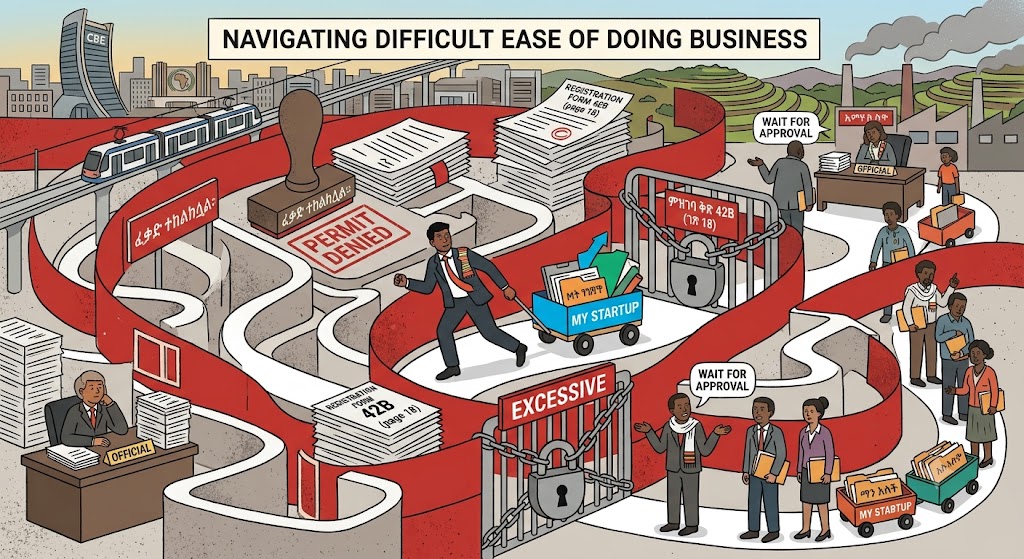
Over the last ten months, he spent weeks moving between tax offices, licensing authorities, municipal offices, and regulatory agencies to renew permits and secure approvals. Every visit required new paperwork. Every desk seemed to demand a stamp from another desk. Some documents expired before the next office completed its own procedures.
“I spend more time processing papers than selling products,” he says.
RELATED POSTS


His story is neither unique nor confined to Addis Ababa.
Across Ethiopia, from small retailers in Hawassa and Bahir Dar to manufacturers in Adama and service providers in Dire Dawa, entrepreneurs increasingly describe the same reality: starting a business is hard, but keeping one alive has become even harder.
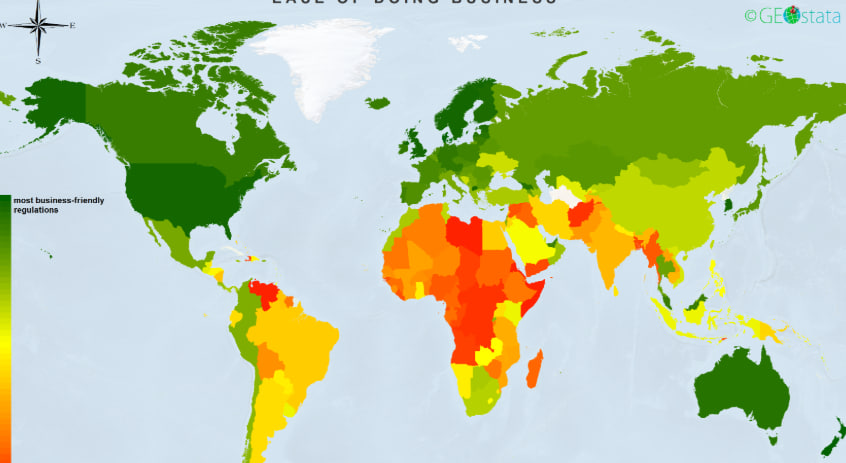
The World Bank’s latest Doing Business assessment ranked Ethiopia 159th out of 190 economies. The country’s score slipped slightly from the previous year, reflecting a deterioration rather than an improvement in the regulatory environment, with particularly weak performance in starting a business, obtaining credit, trading across borders, and enforcing contracts. Although the index has since been discontinued, its findings remain one of the clearest international benchmarks of the country’s regulatory environment. More importantly, many of the obstacles it identified continue to shape the daily reality of Ethiopian businesses.
The World Bank’s assessment did not measure profitability or market potential. Rather, it examined how easily businesses could comply with government regulations throughout their life cycle.
The index evaluated ten areas of business regulation: starting a business, dealing with construction permits, getting electricity, registering property, obtaining credit, protecting minority investors, paying taxes, trading across borders, enforcing contracts, and resolving insolvency.
Across many of these indicators, Ethiopia consistently lagged behind regional and global peers. Between 2015 and 2020, the country’s overall score remained low before falling to 48 points in 2020, suggesting that regulatory reforms had yet to produce meaningful improvements in the day-to-day experience of businesses.
Yet the challenge facing Ethiopian businesses today extends far beyond ordinary bureaucracy.
Molla Alemayehu of the Ethiopian Economic Association observes that Ethiopia’s business difficulties stem from a broader institutional failure to support enterprises according to their capacities and needs. While policymakers frequently describe small and medium-sized enterprises (SMEs) as the backbone of the economy, he argues that meaningful support has largely failed to materialize.
“We continue to talk about SMEs as engines of growth,” he observes, “but beyond the rhetoric, there is little systematic effort to strengthen them.”
That disconnect between policy ambition and institutional execution has become one of the defining characteristics of Ethiopia’s business environment.
Beyond the bureaucracy chokepoint, entrepreneurs describe an operating environment defined by overlapping regulations, lengthy licensing procedures, unpredictable tax administration, deep-rooted corruption, chronic shortages of foreign exchange, inconsistent regulatory enforcement, and weak coordination among public institutions.
The result is an economy where entrepreneurship often survives despite the system rather than because of it.
The Licensing Maze
In theory, licensing protects consumers and ensures standards. In practice, many business runners argue that licensing has become excessively complicated.
Business owners frequently describe an exhausting cycle of obtaining, renewing, modifying, and updating licenses and permits.
For a small business, a license is the passport to formal economic participation. But obtaining and maintaining a business license in Ethiopia feels like an administrative punishment.
According to historical benchmarks from the World Bank’s Doing Business data (where Ethiopia ranked 159th globally and a staggering 168th specifically in Starting a Business), an entrepreneur has to navigate roughly 11 distinct corporate procedures just to open their doors. This process takes over a month under ideal conditions, compared to much faster turnarounds in regionally competitive economies like Rwanda or Kenya.
Abdi, for example, told The Reporter Magazine that it took him months just to make his way through the bureaucratic process of obtaining a business license.
The drawn out process starts with identifying an office space, then moves on to notary verification, trade name search and registration, commercial registration, obtaining a taxpayer ID (TIN), official inspections, and finally license issuance.
If a business changes its physical address by even a block, the entire commercial registration process must often be restarted from scratch, requiring fresh lease notarizations and physical inspections by municipal officials who are perpetually “out of the office.”
Overlapping Regulations
Every weekday at eight o’clock, before unlocking the steel doors of her cosmetics shop in Addis Ababa’s bustling Megenagna district, Meseret carries two bags.
One contains invoices, calculators and receipt books.
The other contains documents. Not one or two documents, but an expanding collection of business licenses, tax clearance certificates, VAT registration papers, municipal permits, lease agreements, inspection reports, customs records and photocopies of identification cards—each carefully organized because experience has taught her that no government office ever asks for only one document.
“Every office wants another paper,” she says with a tired smile. “If they ask for one stamp today, tomorrow they ask for another. I spend more time processing papers than selling products.”
According to World Bank analysis, compliance with government regulations consumed nearly 20 percent of senior management’s time in Ethiopia, substantially higher than in countries such as China, India, and Vietnam. The same report found that the cost of starting a business relative to income levels was among the highest in the comparison group.
One of the most common complaints among Ethiopian businesses is not simply the number of procedures. It is their interdependence. Should any document expire before the chain concludes, the process may begin again.
Institutionally, each requirement may appear reasonable. Collectively, they produce what management experts describe as administrative complexity.
As Molla argues, enterprises fail not because they lack entrepreneurial capacity, but because they operate without institutional support tailored to their scale and circumstances.
“The main problem,” he says, “is that businesses are not being supported in ways that match their actual needs.”
Instead of parallel processing, agencies frequently operate sequentially. Instead of sharing information electronically, businesses become the couriers carrying documents between offices.
Each challenge alone may appear manageable. Together, they form what economists call a high transaction-cost economy, one in which businesses devote an extraordinary share of their resources not to producing goods and services, but to navigating institutions.
For small businesses, this means owners often become full-time administrators rather than entrepreneurs. Many business associations argue Ethiopia could move further in that direction.
The Tax Burden
Many business owners complain that the problem is not only how much tax they pay, but how taxation is administered.
Tax administration has consistently ranked among the most serious concerns identified by Ethiopian businesses. Surveys and public-private consultations have repeatedly listed tax administration among the country’s most binding constraints to private sector growth.
Small enterprises often report facing frequent audits and inspections; complex filing requirements; disputes over tax assessments; multiple tax obligations at different administrative levels; and limited clarity regarding changing regulations.
Molla observes that the problem is deeper than administrative inefficiency. In his view, Ethiopia’s tax framework largely fails to distinguish between businesses of vastly different capacities.
“Unless we provide small businesses with tailored tax treatment,” he argues, “the current system simply pushes them out of the market.”
Unlike many countries that offer graduated tax regimes, simplified compliance procedures or temporary incentives for small enterprises, Ethiopia’s tax administration often imposes similar compliance expectations on businesses regardless of their size or stage of development. As a result, enterprises with limited financial and administrative capacity shoulder a disproportionate burden.
“The little income they earn simply to survive is absorbed by taxes and compliance costs,” Molla notes. “If that continues, their exit from the market becomes inevitable.”
For smaller enterprises operating with thin profit margins, even minor compliance disputes can threaten survival. The consequence extends beyond individual firms. When small businesses struggle to survive, economies lose one of their most important engines of employment, innovation and competition.
Corruption: The Cost Nobody Records
Official statistics rarely capture the full economic cost of corruption. Yet business surveys indicate that corruption remains a significant concern. Surveys conducted over the years show that many firms identify corruption as a major business constraint, while some report expectations of informal payments in dealings involving permits, contracts, inspections, and licenses.
The impact goes beyond the direct payment. Corruption creates uncertainty. An entrepreneur never knows whether approval depends on meeting legal requirements or satisfying unofficial expectations. This unpredictability discourages investment and rewards connections over productivity.
For small businesses lacking political influence or personal networks, the playing field becomes uneven. A trader in a regional town may spend months waiting for approvals while a competitor with stronger connections completes the same process in weeks.
The hidden consequence is declining trust in institutions.
Small Businesses Carry the Heaviest Burden
Where large corporations have lawyers, accountants, consultants, and government-relations departments, small businesses often have little more than their owners.
The owner manages procurement, sales, taxes, compliance, staffing, logistics, and customer relations. Every additional administrative burden falls directly on the owner.
A tailor in Addis Ababa, a furniture maker in Jimma, a grain trader in Dessie, or a small manufacturer in Adama faces challenges that go far beyond normal business risk.
Many entrepreneurs report that regulatory compliance costs consume resources that could otherwise be invested in expansion, hiring, innovation, or improved service. As a result, some businesses remain deliberately small to avoid additional regulatory exposure. Others move partially into the informal sector. Some simply close.
Across the world, small and medium-sized enterprises account for the overwhelming majority of businesses and generate most private-sector employment. They are widely recognised as the foundation of innovation, competition and inclusive economic growth.
Molla argues that while Ethiopia acknowledges this principle rhetorically, it has failed to translate it into effective policy.
“Everyone says small businesses are the engine of growth,” he observes. “The real question is whether we are providing what they actually need.”
His answer is unequivocal.
“We are not.”
He argues that institutional attention toward SMEs has steadily diminished. Earlier initiatives that promoted entrepreneurship through dedicated programmes, public dialogue and development-partner support have largely faded. While isolated projects continue, he says there is no comprehensive institutional framework capable of addressing the sector’s structural challenges.
“The discussion has almost disappeared,” he says. “There is no organisation actively identifying their problems and systematically solving them.”
That institutional vacuum leaves entrepreneurs to confront increasingly complex economic conditions largely on their own.
Access to Finance: Credit Exists, But Not for Everyone
Even when an entrepreneur secures a license, survives the tax assessments and enduring the overlapping regulations and other challenges, they run face-first into a rigid financial bureaucracy. Access to credit remains one of the most persistent challenges facing Ethiopian small and medium-sized enterprises.
On the structural metrics for credit in the World Bank’s yearly assessments, Ethiopia historically ranked near the bottom of the world at 176th.
Banks routinely demand fixed property (like a building in Addis Ababa) valued at 150 to 200 percent of the loan amount. Movable assets or inventory are rarely accepted. On top of that, banks tend to prioritize massive public infrastructure projects and state-owned enterprises, which traditionally consume the lion’s share of domestic credit, leaving crumbs for the private retail sector.
Molla considers this the single greatest obstacle confronting Ethiopian businesses.
“The primary bottleneck is access to finance,” he argues. “Businesses cannot compete because they cannot obtain the capital they need.”
Heavy collateral requirements, he says, effectively exclude the very enterprises expected to generate employment and innovation.
“There is currently no institution capable of solving this problem,” he says. “Without financing that reflects the realities of small businesses, they simply cannot grow.”
The consequences extend far beyond individual firms. Businesses unable to modernize equipment remain less productive. Manufacturers postpone expansion. Retailers struggle to increase inventories. Promising start-ups fail to commercialise new ideas.
Ultimately, constrained finance becomes constrained productivity.
Across successful emerging economies, governments have increasingly complemented commercial lending with credit guarantees, development finance institutions, SME-focused lending programmes and alternative collateral frameworks that reduce risks for lenders while expanding access for viable businesses.
Molla argues that Ethiopia urgently requires similarly structured, institutional solutions rather than continued rhetorical commitments.
“Unless we identify exactly what businesses need and systematically address those gaps,” he warns, “we will continue repeating the same problems.”
The Missing Link Between Reform and Reality
The country stands at a historic economic crossroads.
After decades of state-led development, policymakers have embarked on ambitious macroeconomic reforms intended to liberalize markets, attract private investment, modernize the financial sector and integrate more deeply into the global economy. The government has opened sectors once reserved for state monopolies.
These reforms have generated optimism among investors. Yet optimism alone does not reduce bureaucracy..
Whether those reforms succeed will depend not only on policy announced in documents but also on the everyday experience of entrepreneurs standing in government offices, waiting for approvals that determine whether investments move forward—or remain indefinitely on hold.
Macroeconomic reform can stabilize an economy. However, it cannot automatically simplify the everyday experience of doing business on the ground.
This is where Molla sees the greatest disconnect.
“The problem is not simply that businesses face many challenges,” he says. “The real problem is the lack of commitment to identify those challenges and address them systematically.”
In his view, public policy has too often focused on broad economic objectives while overlooking the practical constraints that determine whether businesses can survive and expand.
Without stronger institutional support, he argues, even well-designed macroeconomic reforms will struggle to deliver their full economic potential.
Molla urges the government to build the institutional architecture necessary to help these businesses grow.
“Unless we identify exactly where the gaps and overlaps exist and work methodically to remove them, we will continue moving in the same cycle,” he says.
Ethiopia is often described as a country of entrepreneurs. Its markets are vibrant, its population is young, and its businesspeople are remarkably resilient. Yet resilience should not be mistaken for efficiency.
The question is no longer whether Ethiopian entrepreneurs are capable of succeeding. Every day they demonstrate that they are. The more pressing question is whether the country’s institutions are making business doing easier or harder.
When business owners spend more time collecting stamps than serving customers, more time negotiating regulations than expanding production, and more time navigating bureaucracy than creating value, economic growth inevitably slows.
The greatest obstacle facing many Ethiopian businesses today is not a lack of ideas, ambition, or effort. It is the growing gap between entrepreneurial energy and the systems meant to support it.
Bridging that gap will require more than incremental reform. It demands a sustained commitment to simplify regulation, improve coordination across government, expand access to finance, modernize tax administration and place the needs of productive enterprises at the centre of economic policy.
“Without a thriving business sector, we cannot build a strong economy,” cautions Molla.