
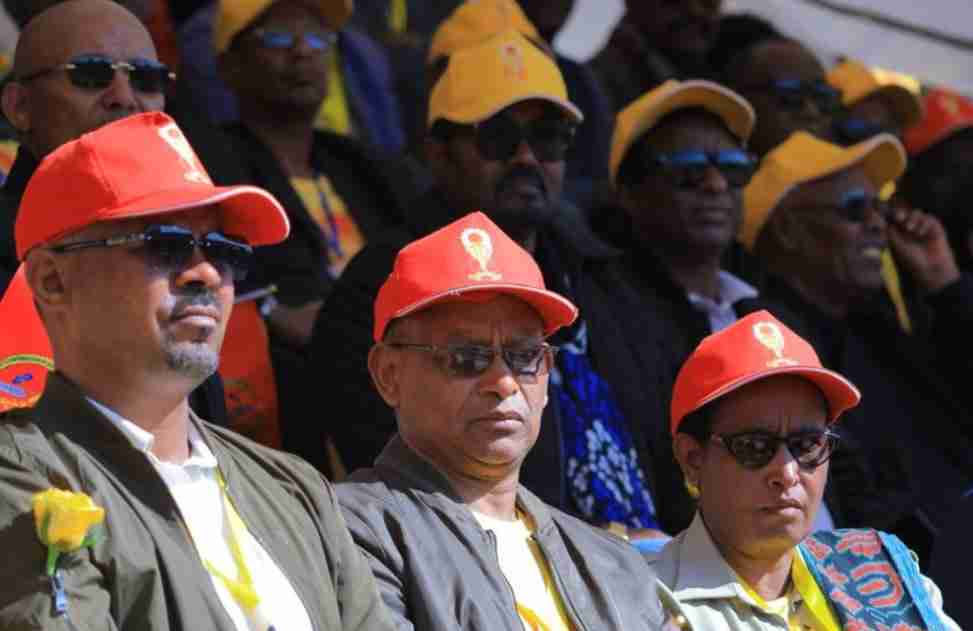

A controversial draft proclamation recently approved by the Tigray People’s Liberation Front (TPLF) in the Tigray regional state has drawn fierce condemnation from opposition political parties. Critics accuse the TPLF of using the law to crush dissent, silence free expression, and legitimize the forced conscription of youth.
Labeled a “Draconian Law” by some Tigrayan activists, the legislation dictates that individuals and media outlets in the Tigray region who oppose military mobilization, criticize the armed struggle, or are accused of obstructing defense efforts could face severe penalties, including prison sentences of up to 25 years.
In a highly controversial move, the legislation is designed to be retroactive. Rather than taking effect from its date of ratification, the law reaches back in time to November 1, 2020—the day the devastating two-year war erupted in northern Ethiopia.
RELATED POSTS

Opposition political parties have condemned the draft proclamation as an instrument to stifle regional dissent. Amdom G/Silassie, Chairman of Arena Tigray for Democracy and Sovereignty, an opposition party based in Tigray, denounced the new proclamation as “highly repressive.” He argued that it severely restricts freedom of speech, thought, and movement while denying fundamental human rights. “We have not accepted it,” he said.
Describing the law as a brazen copy of “Eritrean-style repression,” Amdom warned that the draft has sparked fears of a sweeping crackdown. He characterized the measure as an attempt by the TPLF to salvage its deeply deteriorated legitimacy in the Tigray region. According to Amdom, the regulation was implemented to restrict movement, facilitate military control, and prevent any organized opposition from rising. He believes a primary intent of the law is to give legal cover to forced military conscriptions already occurring across Tigray.
He further argued that such restrictions did not begin with this proclamation. He noted that journalists, activists, and politicians had already been systematically targeted through both social and mainstream media campaigns, forcing many to flee the region. According to Amdom, authorities had previously compiled lists of suspected opponents, making this regulation little more than the formalization of existing practices.
“In reality, forced roundups and crackdowns were already being carried out, particularly in places like Adigrat, Aksum, and Shire,” he said. “They are simply trying to give those actions legal cover now. Activists, politicians, and journalists who express dissent are forced to leave the region. The TPLF designed this repressive law to silence protests, enforce military service, and prevent any form of resistance.”
He added, “In areas such as Shire, Aksum, and Tembien, some have even been shot and killed to enforce conscription. This completely violates the country’s constitution, suppressing both democracy and human rights.”
The draft proclamation imposes a legal obligation on any individual of Tigrayan descent whose age and health permit them to answer the call to military service. For those who fail to meet this obligation, the decree mandates a financial penalty ranging from 10,000 to 50,000 birr. However, it explicitly states that paying the fine does not exempt an individual from service.
Birhan Atsibiha, Public Relations Head of the Salsay Woyane Party, offered a similarly critical assessment, focusing on the substance of the proclamation issued by the TPLF faction led by Debretsion Gebremichael (PhD). He stated that the proclamation was crafted around a narrative of a “survival struggle.” Similar to Amdom, he argued that under this framework, authorities are restricting fundamental rights—including freedom of expression, movement, and political opposition—in ways that contradict both constitutional guarantees and international legal standards.
Birhan noted that the proclamation grants security forces broad powers to conduct searches and imposes harsh penalties on those who refuse to comply. “It is not only about targeting those who openly oppose them,” Birhan said. “They are demanding complete alignment with their narrative. Anyone who does not conform or who acts independently is treated as an enemy.”
He noted that the lengthy prison sentences and substantial financial penalties severely undermine freedom of expression and democratic participation for ordinary citizens, civil society organizations, and opposition parties alike. Describing the measures as authoritarian, Birhan argued they are being implemented through coercion because they lack public support. Although discussions about potential amendments have occurred, he maintained that core concerns remain unresolved.
In his view, the law effectively tells people that if they do not obey, they will be targeted. “In that sense, it can be described as a harsh and authoritarian decree against the will of the people,” he said.
Asked why such measures were being introduced at this particular moment, Birhan pointed to the emergence of reform movements and increasingly active opposition parties within Tigray. He noted that the TPLF has acknowledged its own strategic leadership failures, internal fragmentation, and political defeats, which have weakened its ability to organically mobilize the youth. “Tigray will achieve nothing through another war except further loss of life and the risk of plunging the country into a crisis from which recovery will be extremely difficult,” he warned.
Kebede Assefa, Chairman of the 70 Enderta Political Party, also rejected the draft law as an illegitimate instrument. “The body drafting this document lacks the legal mandate, authority, and constitutional basis to enact legislation,” he stated.
Kebede’s view is shared by Tesfalem Berhe, a lawyer and human rights advocate, who called the law a “tool for oppression.” As Tesfalem put it: “The law fundamentally opposes the spirit of justice and is designed to put those targeted by the TPLF behind bars.”
Both Kebede and Tesfalem argue that the Tigray Regional Council lost its legal standing due to the two-year war and subsequent constitutional disruptions. Despite this, the group reconvened under the banner of a council and declared itself a government. “This so-called government, born from an expired mandate, appears to believe that the possession of armed power gives it the right to act without restraint,” Kebede said, calling the draft a demonstration of unchecked power.
From a legal perspective, both experts emphasized that criminal laws cannot be applied retroactively to November 1, 2020, and argued that the draft flagrantly violates this fundamental legal principle. Kebede noted that the draft proclamation would empower local cadres and security personnel to exercise authority arbitrarily, creating ripe conditions for abuse. “We view the decree as a terror proclamation,” he said, criticizing provisions that grant sweeping authority over individuals regardless of their location as excessive and incompatible with basic civil liberties.
Tesfalem reiterated that the draft is an “unconstitutional instrument of oppression” rather than a legitimate piece of legislation. He added that the regional council has long outlived its constitutionally mandated five-year term limits. “Under both the federal and Tigray regional constitutions, there are absolutely no exceptional provisions or legal loopholes that allow a regional council to extend its legislative mandate.”
He further clarified: “Even if the Tigray Regional Council were fully legitimate and constitutionally valid, it would still lack the legal authority to enact this type of criminal legislation. Under the federal structure, heavy criminal offenses are strictly reserved for federal jurisdiction, explicitly covered under the comprehensive federal criminal code. By attempting to codify these severe criminal penalties independently, the regional decree directly clashes with both federal and regional constitutional frameworks.”
For Tesfalem, the most alarming aspect of the decree remains its blatant violation of criminal law principles regarding retroactivity. “The proclamation seeks to penalize actions dating back to November 2020; a move that directly contravenes both the constitution and international human rights conventions, which strictly prohibit retroactive criminal liability,” he explained. He warned that the decree represents a serious erosion of the rule of law, masquerading as legitimate legislation while violating basic human rights.
Kebede concluded by citing provisions that restrict freedom of movement, arguing they could be used to punish young people for simply traveling between rural and urban areas, or even between households, without explicit authorization. He maintained that the draft’s retroactive provisions are fundamentally intended to penalize individuals for their past political views and activities, and called on Tigrayan scholars and the international community to speak with a united voice against the draft law.