
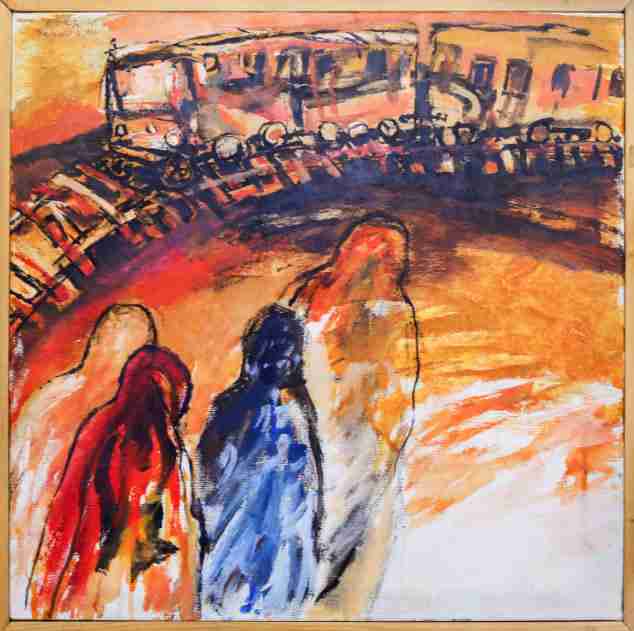

His artistic practice was characterized by a tension between academic discipline and instinctive expression, drawing influence from formal instruction, personal memory, and the visual language of childhood. A painter and educator, Behailu Bezabih spent a lifetime mastering the rules of art, only to spend the rest of it trying to forget them.
Colleagues often described him as possessing “the soul of a child,” a phrase that captured what many believed set his work apart: an ability to see the world without the filters of rigidity or exhaustion that formal training can sometimes impose. In his paintings, this translated into an “innocent eye”—a mode of perception rooted in curiosity, openness, and emotional immediacy. In contemporary art discourse, this condition is often described as “unlearning,” the process of shedding inherited artistic rules to recover instinct. According to artist and Alle School of Fine Arts and Design director Agegnehu Adane, Behailu was one of the rare practitioners who achieved this balance without losing the rigor of his training.
“Formal knowledge can sometimes bind your hands and clash with pure creative freedom,” Agegnehu told The Reporter Magazine. “Because navigating this balance is so difficult, there is a trend of trying to unlearn things, and Behailu was someone who completely succeeded at it.”
RELATED POSTS

That balance between discipline and instinct did not develop in isolation. It was shaped within a broader shift in Ethiopian contemporary art, where a generation of artists began searching for new forms of expression outside the constraints of earlier academic and political frameworks. It was within this climate that Behailu became closely associated with the Dimension Art Group, a collective that emerged in the mid-1990s as one of the most significant turning points in contemporary Ethiopian art.
In her book Modernist Art in Ethiopia, art historian Elizabeth W. Giorgis describes the formation of the Dimension Art Group in 1995 as part of a broader search for new creative freedoms after years of artistic rigidity under the Derg regime. The collective took its name from the Amharic word awtar, the tightened strings of a harp, each producing its own sound while contributing to a larger melody. Giorgis identifies Behailu among the group’s most experimental members, writing that his 2001 work L’Arc de Triomphe carried “the animated and anarchic energy of childhood,” a quality that remained central to both his art and teaching.
“At that time, the local contemporary art scene was virtually non-existent,” Bekele Mekonnen told The Reporter Magazine.
That absence shaped the urgency of the group’s formation. The Dimension Art Group emerged as a response to a limited artistic infrastructure and a need for shared experimentation. It organized exhibitions and discussions that helped define a new language for contemporary Ethiopian art, primarily through venues such as the Alliance Ethio-Française. The collective organized annual exhibitions, alongside discussions that drew artists, students, and writers from across Addis Ababa. “It played a foundational role in shaping the contemporary Ethiopian art movement we see today,” Bekele told The Reporter Magazine.
This philosophy shaped not only Behailu’s paintings but also the objects he surrounded himself with throughout his life: school desks, exercise books, blackboards, chewed pencils, and classroom remnants that later became central to his artistic practice. Much of his work emerged from ordinary materials most people ignored; discarded pencils, classroom tools, scraps of paper, and fragments of daily life were transformed into reflections on memory and education.
One exhibition, recalled vividly by colleagues, assembled exercise book covers from different political eras, beginning with the reign of Emperor Menelik II, through the Derg period, and into contemporary Ethiopia. According to Agegnehu, the exhibition quietly traced how Ethiopian society’s ideas about education and childhood had changed over time.
“He tried to present a comprehensive survey tracing where our philosophy of education started and where it has headed,” Agegnehu said. “For example, tracing how exercise book covers went from featuring educational themes to printing pictures of football players and pop singers.”
Rather than making direct political arguments, Behailu allowed the objects themselves to reveal those shifts. Old notebooks, damaged desks, and classroom fragments became records of changing national values, exposing how generations of Ethiopian children were taught what to admire, pursue, and become.
Behailu graduated from the Alle School of Fine Arts and Design in 1980 before later earning a Master of Fine Arts in New Media from the Transart Institute, which is associated with Berlin and New York. Over the course of a career spanning more than four decades, he exhibited internationally in cities including New York, Dublin, Berlin, Nairobi, Johannesburg, Madrid, and Cairo. His work appeared at institutions including the Irish Museum of Modern Art, the Goethe-Institut Berlin, the National Museum of Ethiopia, and the Alliance Ethio-Française.
But colleagues say Behailu’s significance cannot be measured solely through exhibitions, awards, or international recognition. What distinguished him most was the artistic language he developed by combining formal education with emotional openness and curiosity.
“When we were students, we followed his exhibitions closely,” Agegnehu recalled. “We would meet him, learn how to work, and listen to him present his ideas.”
During the 1980s and 1990s in the Ethiopian calendar, Behailu became one of the defining figures within Addis Ababa’s contemporary art scene. Younger artists admired not only his paintings but also his consistency. At a time when Ethiopia offered artists little institutional support, Behailu continued staging solo exhibitions once or twice nearly every year.
“Holding a solo exhibition shows a massive level of confidence,” Agegnehu told The Reporter Magazine. “And his were considered very prestigious.”
That style drew partly from Expressionism, characterized by emotional intensity, psychological exploration, and abstraction. Yet colleagues insist Behailu’s work carried something distinctly his own. His paintings often explored Ethiopian urban life, social gatherings, education, migration, politics, and childhood imagination through compositions that felt simultaneously sophisticated and playful.
Bekele Mekonnen—an artist, assistant professor at the Alle School, and fellow founding member of the Dimension Art Group—described Behailu’s paintings as deeply personal and technically mature while still retaining an unusual sense of joy.
“Anyone can try to paint, but only true masters can capture that level of depth,” Bekele said. “His colors were incredibly vibrant, and he delivered his themes with a certain playfulness.”
Bekele compared aspects of Behailu’s work to Russian-French painter Marc Chagall, whose dreamlike compositions drew heavily from folklore and memory. But ultimately, Bekele said, Behailu’s greatest influence came from children themselves. “He had an African, childlike soul,” he said.
That quality was inseparable from Behailu’s life as an educator. He taught for decades, beginning at Hiwot Berhan Elementary School before later becoming an instructor and lecturer in new media at the Alle School itself. According to Bekele, he also spent years teaching at the International Community School in Addis Ababa.
According to Agegnehu, children shaped not only Behailu’s subject matter but his entire way of seeing. “Often, as people acquire knowledge and formal education, they become rigid or cynical,” he said. “They lose their childhood innocence and freedom.”
Behailu, however, seemed to move in the opposite direction.
His graduation piece, titled To Dima, already hinted at the themes that would define the rest of his career. The work depicted a child wearing a traditional sheepskin cloak bidding farewell to a church school family—an image centered on transition, education, and childhood.

Even as his career expanded internationally, education remained central to his work. Published archival material repeatedly described his practice as expressionistic, spontaneous, experimental, and socially reflective. The Irish Museum of Modern Art described his paintings as instinctive responses to “a world of fast-moving ideas,” while Alliance Ethio-Française archives linked the spontaneity of his work directly to his years spent teaching children.
Agegnehu recalled one exhibition titled Phoenix, which used the mythical bird rising from ashes as a metaphor for upheaval, destruction, and renewal within Ethiopian society. “He built a vision showing that something new would be born out of the chaos,” Agegnehu said.
Despite Behailu’s international recognition, both Bekele and Agegnehu believe artists of his generation remained under-recognized domestically.
“To be honest, we don’t really have a structured art industry here,” Bekele said. “He did everything on his own and promoted himself through his own sheer merit until his talent was recognized on the global stage.”
Behailu nevertheless earned significant recognition abroad, including a grant from the Pollock-Krasner Foundation. Yet both men insist his personality left as deep an impression as his work.
“He was someone who lived his life with a completely clean slate, starting from absolute zero emotionally and spiritually,” Bekele said. “He never claimed to be superior to anyone else.”
Agegnehu described Behailu as unusually humble for someone of his stature. “Often, knowledge and humility don’t go hand in hand,” he said. “But when the two unite harmoniously in a person, that individual is no ordinary human being.”
Bekele recalled learning of Behailu’s death while in the United States, only weeks after seeing him in Addis Ababa. “We went together to buy a book a few weeks before his death, before I left for America,” he said quietly. “Losing him is a massive loss for the country.”
Then he paused.
“He would literally give you the shoes off his feet if you needed them.”
Even in his final years, friends and colleagues continued to describe him as unusually youthful in spirit, retaining the openness and humility they believed defined both his life and work. What remains now is not simply the legacy of a celebrated painter, teacher, or mentor, but the example of an artist who spent his life resisting cynicism. Behailu Bezabih studied children closely enough that, according to those who knew him best, he never entirely stopped seeing the world the way they do: openly, instinctively, and without fear.
Behailu Bezabih passed away on April 10, 2026, at the age of 66. He is survived by his three children.