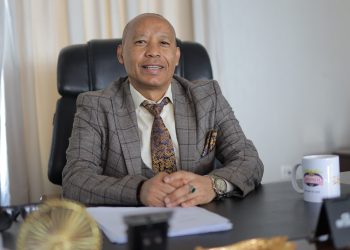


Professor Thomas Tieku is a Ghanaian-Canadian negotiation and international organization expert and a professor of politics and international relations at the University of Western Ontario in Canada.
A keen observer of African Union (AU) matters, Professor Tieku has made significant contributions to academic discourse relating to the organization. He has dedicated himself to in-depth study of the AU since 1999, cultivating a nuanced understanding of its operations.
Professor Tieku holds a distinct and rare perspective on the real power of the AU Commission and its chairperson, the way AUC has been designed, as well as the impact of external funding on decision making.
RELATED POSTS


As the continental organization prepares for the election of a new chairperson, The Reporter Magazine’s Bewket Abebe sat down with the Professor to get an inside look at the process and its significance for Africa. Tieku shared his thoughts about the AUC; its bureaucratic processes and inefficiencies, the failures and successes of previous chairs, and the kind of influence donors and member states hold over the AU. EXCERPTS:
The Reporter Magazine: The AUC chairmanship election will be held in February, and the three candidates recently took part in a debate here in Addis. Could you share your observations on the overall process, the topics discussed in the debate, as well as the level of engagement from member states, partners and fellow Africans?
Professor Thomas Tieku: I watched the debate from afar. My sense is that the level of engagement is good but it could have been better. For a continent with a lot of youth, it could have been good to engage more of the youth and the diaspora community in the debate process. That is my overall assessment. But, it is a good development that we are at least holding this election and see the candidates sharing their thoughts.
There were some inspiring moments and some disappointments as well in the debate. Some questions were answered well particularly on regional integration and security issues whereas some other questions, particularly on where the candidates stand in relation to the key questions of Pan-Africanism, were not properly answered. That [the latter] tells me one of two things; either those candidates, deep in the heart, do not genuinely believe in Pan-Africanist aspirations beyond using them for rhetorical purposes, or they were not well prepared, which is strange as it reveals how seriously they take this responsibility. If you appear for an interview unprepared for the most central question, the question will then be how prepared are you for the job. That is what I have found disappointing.
My take on the African Union chairmanship is that we do not need a chairperson who is going to learn on the job. We have too many of them. We have had too many of them. They don’t pay much attention to the nuances of the African Union.
The most important role of the chairperson, to me, happens to be his/her symbolic power, not even the substantive power. When you become the AUC chairperson, you are the chief diplomat of the continent. You represent a continent both within and outside the continent. You have to be in the capitals of member states selling the African Union policies, pushing leaders, and getting policies implemented. Decisions are made in Addis Ababa but need to be implemented across the continent. Presidents and leaders have lots of things to do. If you are not on them, they will forget about it. Unfortunately, a lot of times, the chairperson comes to Addis Ababa thinking that their job is to be at the AU’s headquarter in Addis Ababa to micromanage the staff. That is not your number-one job. That is why over 80 percent of the decisions of the African Union have not been implemented. A lot of protocols and legal instruments are not ratified.
Actually, more than 90 percent of them are unratified. Ninety-three percent between 2021 and 2023, according to a recent speech from Chairperson Moussa Faki.
Yes, because we don’t usually have chairperson doing such jobs. How many times have you seen a chairperson of the AUC going to African parliaments to address those AU policies? You don’t see it. How many times have you seen the chairperson of the AU going to the Ethiopian parliament [there in the same city] to address those policies?
Do you attribute the shortcomings to the individual chairperson?
I think I do. A number of chairpersons do not understand that it is their number-one job. That is why the administration of the AUC is in the hands of the deputy chairperson. The chairperson is the forward-facing individual, whereas the deputy is a home affairs minister; a classic bureaucrat taking care of the details in the organization and making sure that the Commission is run efficiently. This is how it is conceptualized.
What we had in the past is chairpersons who do not do their job but prefer to do the job of others. They take this job of an accounting officer micromanaging the organization. Similarly, we see deputy chairpersons going out and delivering speeches and the like, which is not their job. Sadly, the two often get in each other’s way. The division of labor, which is already in the statute, is very important.
That is why the deputy chairperson is not appointed by the chairperson. S/he is rather an independent individual with his/her own authority to make decisions. That is how the statute is designed.
Sometimes when I hear people calling for the need to reform the way the AU is designed, I ask if they understand the way it is designed. It is one of the world’s most well-designed institutions; very innovative. Unfortunately, we appoint people who do not understand that.
How meaningful do you consider the election for the chairperson of the AUC to be? How much attention do you think it deserves?
Enough attention has not been given, in my opinion. I think member states haven’t recognized the moment that the Africa Union finds itself in. They will find out when it is too late. The world is changing from the 1945 creation of the UN and the liberal international order. We were not there [except Ethiopia and Liberia]. Our interests were not taken care of. That system is now at a deadlock. It is not working anymore. That is why we do not have a single permanent seat on the UN security Council. So, are we going to be at the table or are we going to be on the menu. That is the question right now! If we don’t get ourselves ready, we will be on the menu to be eaten alive rather than being at the table enjoying the food. We can’t even do it as individual countries. Sometimes, countries such as Nigeria and South Africa overrate themselves as if they are superpowers. These are just tiny states in terms of political configuration. We need a united kind of continent. When a united Africa speaks, people listen. Therefore, we need a chairperson with a gravitas, with personality, with a diplomatic skill; a chairperson with aspirations to put Africans at the table; so that we can participate in terms of the new norms, power structures, and institutions developed. We had the Summit of the Future. Namibia was the co-chair. But the participation of African countries was very minimal. Namibia became the de facto spokesperson for the continent of Africa. We need a good chairperson.
Speaking of attention given to the upcoming AUC chairmanship election, Kenya, which has presented its former foreign minister Raila Odinga as one of the three candidates, happened to give relatively more attention. What potential avenues exist for nations to serve their own interests by getting their candidates elected?
A good chairperson should, by necessity, be good for the country he comes from. I am from Ghana and I would tell you that when Kofi Annan performed really well as a Secretary-General, Ghanaians benefited tremendously. Not in terms of getting more opportunities to serve there at the UN but in terms of others’ confidence in Ghanaians. That transcended into international universities, NASA, and other institutions. The message it sends surprises you.
But do African member states see it that way? My sense is that many often see it as a means to promote the small interest of their government. That is a very short-sighted view because that representative of theirs will serve them for a limited four to five years. But if you send a good individual who excels, you see a replicate effect on your own citizens in the next 20-25 years globally. It inspires your citizens. Because of Kofi Annan, many youths who aspire to be the next Kofi Annan have been created. This works anywhere else as well.
What ‘small interests’ of his/her government can a chairperson possibly promote?
The chairperson may work on job openings for the citizens of that country not only within the AU but also in other international organizations. On the other hand, any country that happens to be elected, for instance, at the UN Security Council tends to gain more aid. When you have a chairperson, countries often want to do business with you. You watch carefully who the next chairperson is and you will see Western countries trying to do business with that government, thinking that through the government they can influence that individual chairperson.
Some believe the election of a particular individual as a chairperson does not ultimately matter. They argue AU organs, including the AUC itself, do not enjoy meaningful power. But your journal article titled ‘Punching above the weight: How the African Union Commission exercises agency in politics’ and published some five years ago, suggests you believe the contrary. What makes you hold a different view?
I have been working with the AU since its inception. I usually come to the headquarters at least twice a year. I am lucky enough to have contact with almost all the people who even negotiated the constitutive act. I had the opportunity to sit down with some of the individuals who led the process for the creation of the statues of the African Union; the way they thought about it and the way it was being implemented. I have a history of talking and working with a lot of the right people. That is one.
The other thing is that there are people who take what is written in the AU statute in a very literal way. There are a lot of powers that a lot of chairpersons do not exercise.
Why do you think they don’t exercise these powers?
Part of it is because a number of chairpersons lack confidence in themselves. They become puppets of the president.
If you exercise those powers, African presidents do not like you that much. The African Union would not exist if member states were able to solve their problems. And most of the problems the African Union is supposed to solve are created by member states. Who are the member states? Governments. So, if you are going to exercise the powers, you are most likely at loggerheads. That is why the first chairperson of the commission, [Malian] President Konaré, was not given a second term. Because he was involved in the negotiation of the constitutive act and understood both the written and unwritten versions of the statute and exercised them. Ambassadors didn’t really like him.
The statute allows the chairperson to initiate a policy. It does not impose any limits as to the policies that they can initiate. It was no one that pushed Madam Zuma to create Agenda 2063. You can bring together any scholars and experts from around the world and once you have a good intellectual argument and developed a solid policy, presidents do not challenge you.
Do you attribute the ineffectiveness of the AUC to the chairpersons?
Yes. There is a wrong perception within the AUC. Some have convinced themselves that the AU is not an implementation agency. I just don’t know where that idea comes from. You have to nudge member states to do it. If you don’t push them, how do they do it?
Research tells us that governments in every part of the world only implement policies from international organizations when civil society mobilizes domestic constituencies in pushing their government to do it. That is where the missing link is. That is where we have not done well.
If I were a chairperson, the first thing I would do would be going to a parliament, to trade unions, to the business community, and telling people about the agenda. Spend only a small amount of time with presidents. Just go to others and sell the idea. You will be more effective than you think you can be. That is what research tells us. Unfortunately, we don’t do that. What do our chairpersons do? They go to a meeting, they meet presidents and other officials, and then the chairperson is out. That is it. They don’t mobilize Africans. Many Africans do not have the necessary awareness. How can they put pressure on their governments if they are not aware enough? That is the problem.
It is no secret that the AU relies heavily on external funding, even for its administrative budget. Which specific aspects of its decision making do you see compromised and manipulated as a result of external dependence?
I am glad you asked me this question because a lot of people have misperceptions of the African Union, particularly on this issue.
What researchers are telling us is that there is no correlation, let alone causation, between external funding and decision making at the African Union. There is a German scholar who did work on AU funding and decision-making. It has no correlation. Even those who paid often feel that their voices are not heard. This is on us. Not on anyone. Donors tend to influence AU’s policy direction in an indirect way. Let me explain what I mean by that.
The African Union Commission in Addis Ababa often tends to anticipate areas that donors are likely going to fund and tailor policies towards that direction just like the way civil society organizations do. The EU gives more money to, let’s say, migration. Then we do a migration program. Germany gives money to a border program, so we come up with a border program. That is what it is. Oftentimes, it is mainly our own self-censorship that encourages that to happen. In terms of direct interference, there is very little evidence showing a correlation.
Indirectly, too, donors often tend to influence AU decision making through what they call short-term consultancy service; people paid by external donors. These people [the consultants] are mostly Africans. Most of the influence we have is as simple as that. People find it difficult to write something [original] and find it easier to go and copy from the EU or the UN system.
To some extent, dialogue is also donor driven. Initially, donors had this idea that they could pump money into the AU and would be able to influence decisions. But they later realized that they are not able to do that, no matter what money they provide. So, they wanted to change the dialogue.
Let me give you one classic example. The US gave money for the prosecution of South Sudanese who, according to them, committed a crime. It was more than a million dollars. As soon as the money was given, instructions were given to take it back, stating that South Sudan was not interested. The US wanted to go after the ‘perpetrators who committed crime.’ South Sudan said that wasn’t its focus. Similarly, the AU said its interest was to resolve the conflict first and foremost. That money is still there [in the US]. That is what happens. And the structure is already there to prevent it from happening. If you watch carefully, the AU does not have a good absorbing capacity. And in some cases, the AU has rejected the money.
There has also been a situation when donors have given money and told the AU to develop elaborate rules and sometimes copy the rules governing LGBTQ issues in the west. The chairperson, the deputy chairperson, and commissioners said, ‘we are not ready. We are not there yet.’
In the early 2000s, there were ambassadors whose main goal was to get the AU to write rules and promote LGBTQ+ in the African continent. I know an ambassador of one of the few highly influential countries in the world back then. He stayed for four or five years in Addis Ababa fighting for this matter. He was not able to achieve that. The AU hasn’t done that. He expressed his frustration and left. He is an ambassador of a really big country.